Introduction to Lovrabet
TIP
Lovrabet is an enterprise operating platform for activating legacy assets, putting AI into business processes, and turning organizational know-how into assets. It helps enterprises transform the systems, data, processes, and experience they already have into operating capabilities that AI can understand, execute, capture, and reuse.
What is Lovrabet
Lovrabet is an AI-Native enterprise operating platform built for legacy asset activation, AI-powered business processes, and converting organizational know-how into assets.
It doesn't ask you to start over, and it isn't a chat box bolted onto an old system. Lovrabet starts from what the enterprise already has — databases, legacy systems, APIs, SQL, process documents, and human experience — and uses DBAgent reverse engineering, business models, runtime Agents, Skills, knowledge bases, and an enterprise-grade engineering foundation to truly bring AI into the core business flow.
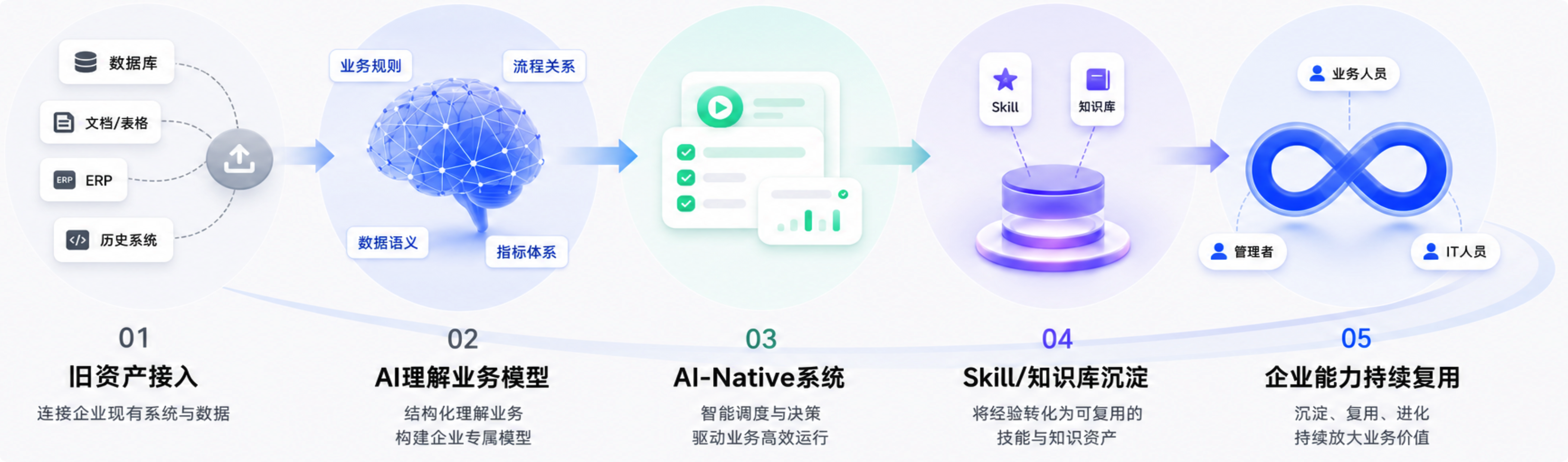
Put simply, Lovrabet helps enterprises run one conversion chain:
旧资产接入
→ AI 理解业务模型
→ AI-Native 系统
→ Skill / 知识库沉淀
→ 企业能力持续复用
This isn't about shipping a traditional system faster. It's about upgrading enterprise systems from "recording results" to "taking part in execution" — moving AI from answering questions to getting business done.
What problem does Lovrabet solve
Enterprise AI adoption isn't stuck on models
Over the past two decades, enterprises have built vast numbers of ERP, CRM, OMS, WMS, finance, approval, project, and operations systems. These systems record orders, customers, inventory, approvals, contracts, collections, and business results — and they hold deep stores of real business rules.
But most of them are still designed for humans to operate: humans interpret the fields, humans switch between systems, humans apply the rules, humans push processes forward — and humans carry the experience away when they leave. However strong AI gets, it often stays at the periphery: writing reports, summarizing, answering questions, assisting development — rarely entering the core business flow.
The real obstacle isn't a lack of AI. It's that the enterprise foundation isn't ready for Agents to operate:
- There's plenty of data, but little business meaning.
- Plenty of systems, but their process actions can't be called reliably.
- Experience is precious, but it lives in people's heads, chat logs, and ad-hoc documents.
- Permissions, audit, transactions, rules, and risk boundaries aren't part of the AI execution chain.
Tokens burning, data standing still
Many enterprises already burn AI tokens continuously — but consumption alone isn't productivity. The real question: do those tokens stay on the office sidelines, or do they enter the core business flows of orders, customers, approvals, risk control, and delivery?
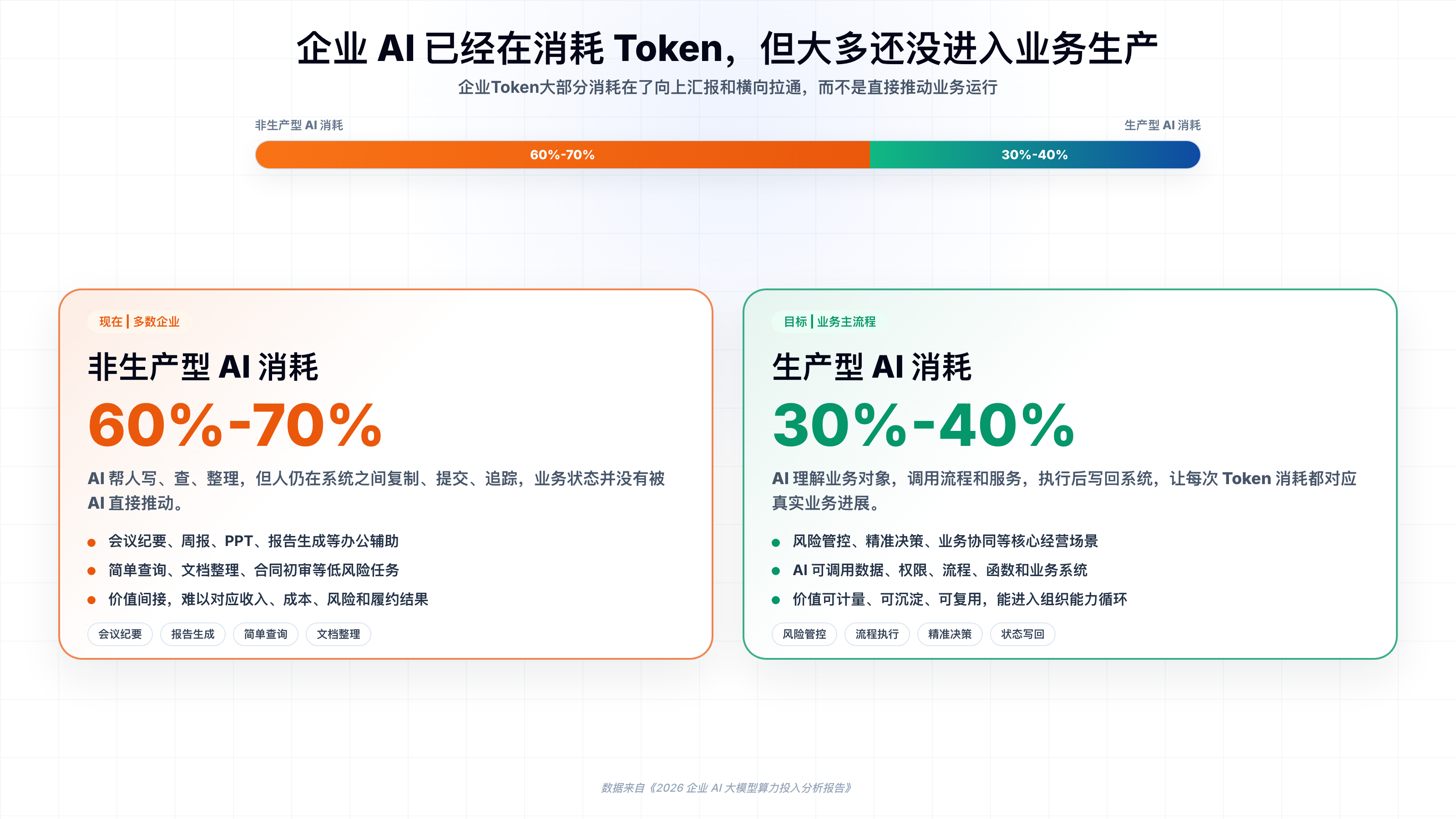
| Real bottleneck | Typical symptom | What's happening inside enterprises | Why it blocks AI adoption |
|---|---|---|---|
| Tokens stuck on the office sidelines | 60%-70% of AI consumption is still concentrated in non-productive scenarios | Meeting minutes, weekly reports, slide decks, report generation, simple queries, and document cleanup get faster — but people still copy, submit, and track across systems by hand. | The value is indirect: it can't be tied to revenue, cost, risk, fulfillment, or write-backs of business status — AI isn't actually moving the business. |
| Core data and logic stay locked up | The most valuable data and business rules usually sit in legacy systems no one dares to touch | With tangled dependencies, no tests or rollback, and fields stripped of business meaning, these systems can record results — but AI can't safely understand or call them. | AI never gets real business semantics and can't reliably call process actions, so it stays at peripheral assistance and surface-level makeovers. |
TIP
What enterprise AI really needs to solve isn't "connect a few more Agents" — it's directing token flow into core business processes and safely activating the data, semantics, and process actions locked inside legacy systems.
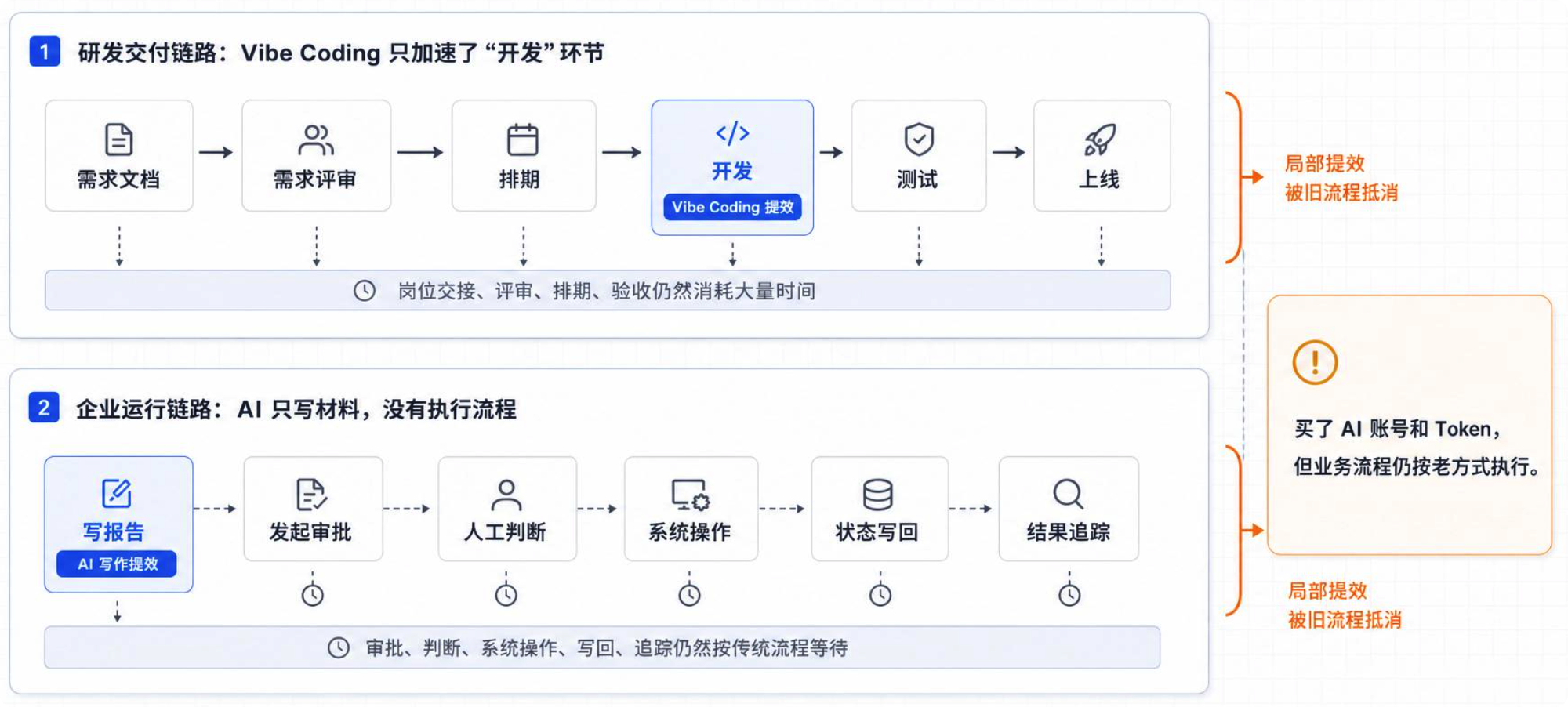
Point improvements in traditional processes can't move overall business efficiency
Enterprise data stays locked away instead of becoming a means of production
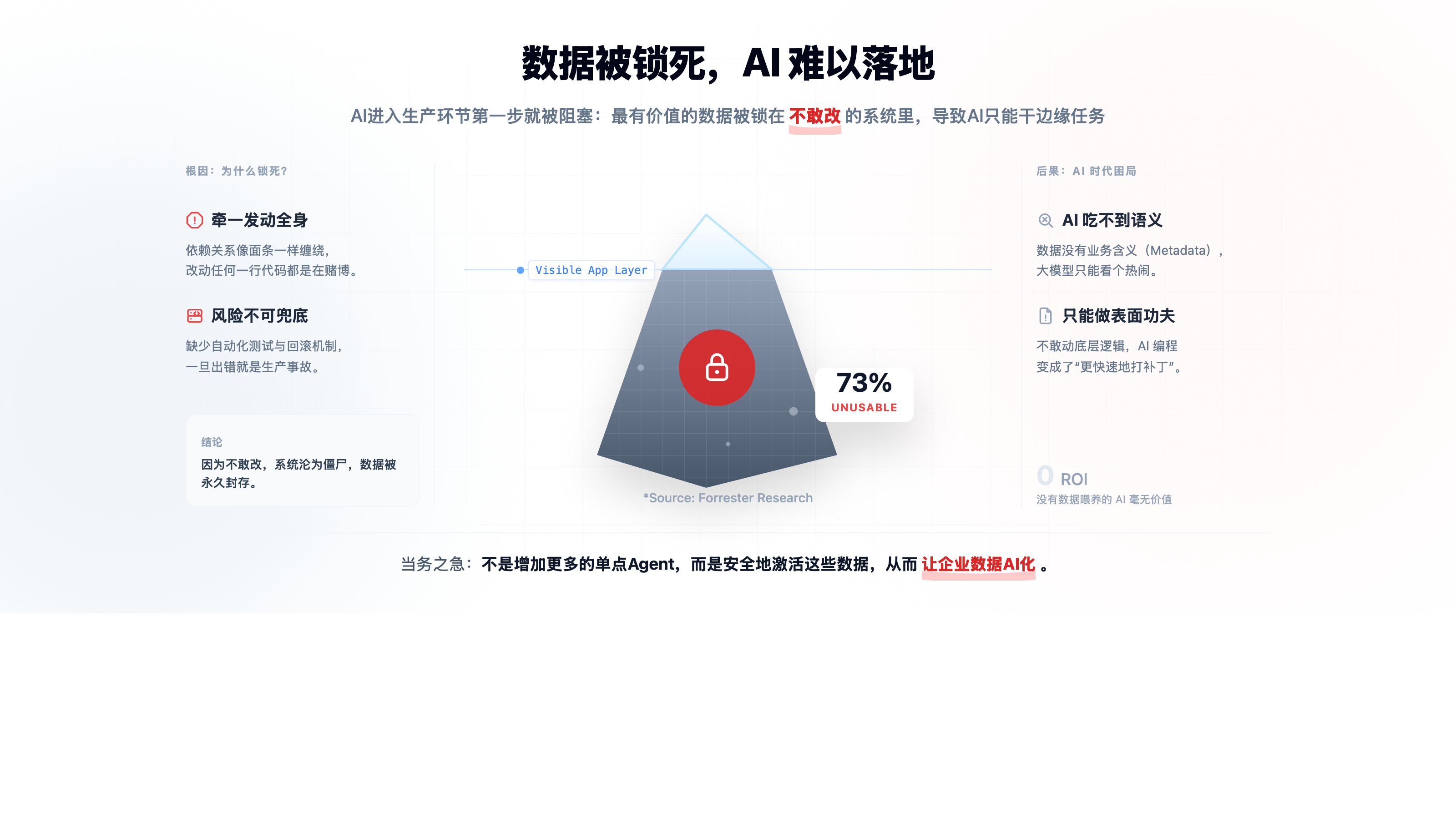
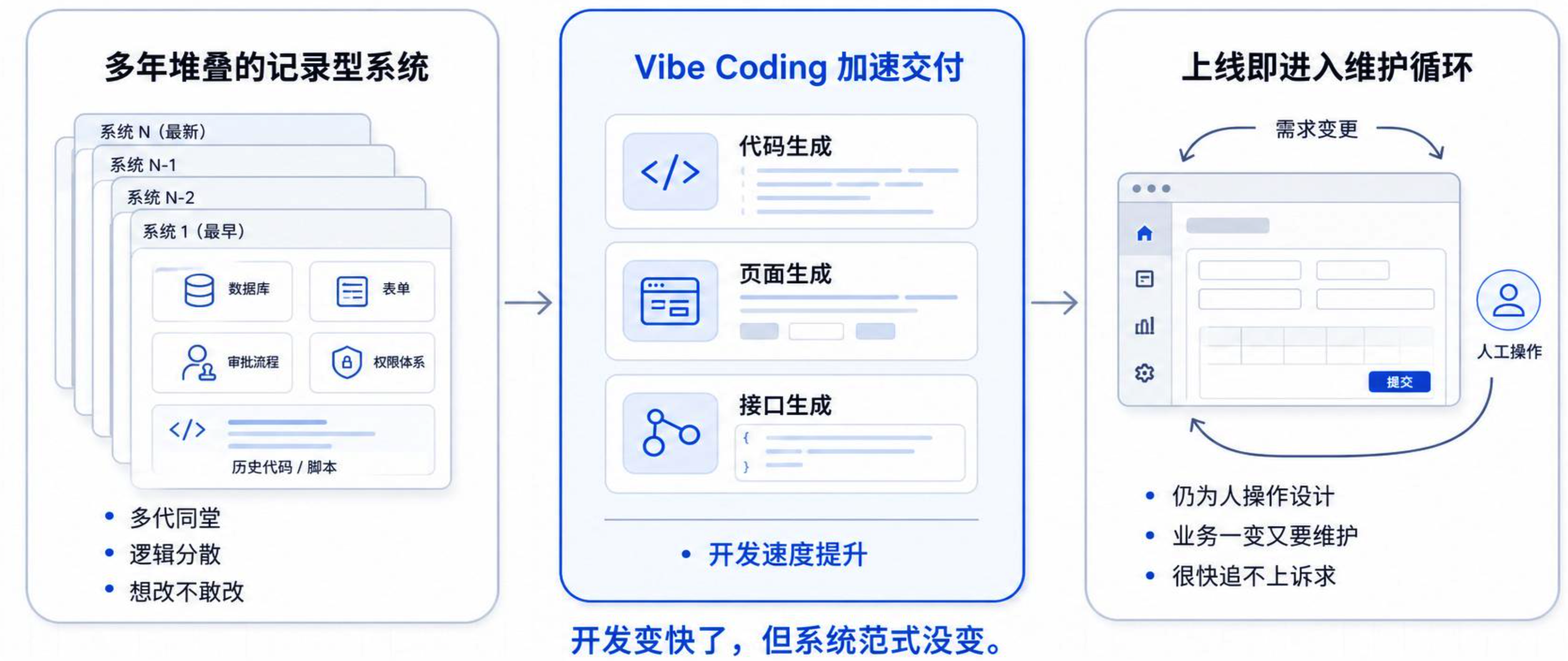
Some 73% of enterprise data lies dormant. Systems of the past were designed for humans to operate and can't be accessed by AI Agents. Smart as AI is, without access to private enterprise data it can't enter business processes — so enterprise AI lands only in non-productive scenarios: administrative work, slide decks, meeting minutes, weekly and monthly reports, image and video generation, and the like.
Vibe coding still delivers traditional record-keeping systems maintained by hand
Lovrabet is not an AI coding platform
If the goal is simply writing code faster, general-purpose AI coding tools are already good enough. If the goal is just generating pages, traditional low-code and page-generation tools cover part of that need.
Lovrabet targets a deeper question: how can an enterprise get AI to understand its business objects, metric definitions, permission boundaries, process actions, and organizational know-how — and keep running within controlled bounds.
| Common approach | Main value | Limitation |
|---|---|---|
| AI coding | Helps developers write and understand code faster | Doesn't acquire enterprise business semantics automatically, and doesn't solve runtime execution |
| Low-code / page generation | Builds forms, lists, and admin pages faster | Still centers on page configuration, not business models, execution assets, or captured know-how |
| Bolt-on AI assistant | Answers questions and offers suggestions beside legacy systems | Can advise, but can't necessarily call the system, write results back, or leave reusable paths behind |
| Lovrabet | Builds AI-Native enterprise operating capability from existing assets | Handles connection, modeling, validation, and capture around real business scenarios |
Lovrabet can generate pages, and it offers CLI, APIs, Skills, and Backend Functions — but those aren't the point. The point is the enterprise's own business capabilities: understood, executed, captured, reused.
How Lovrabet works
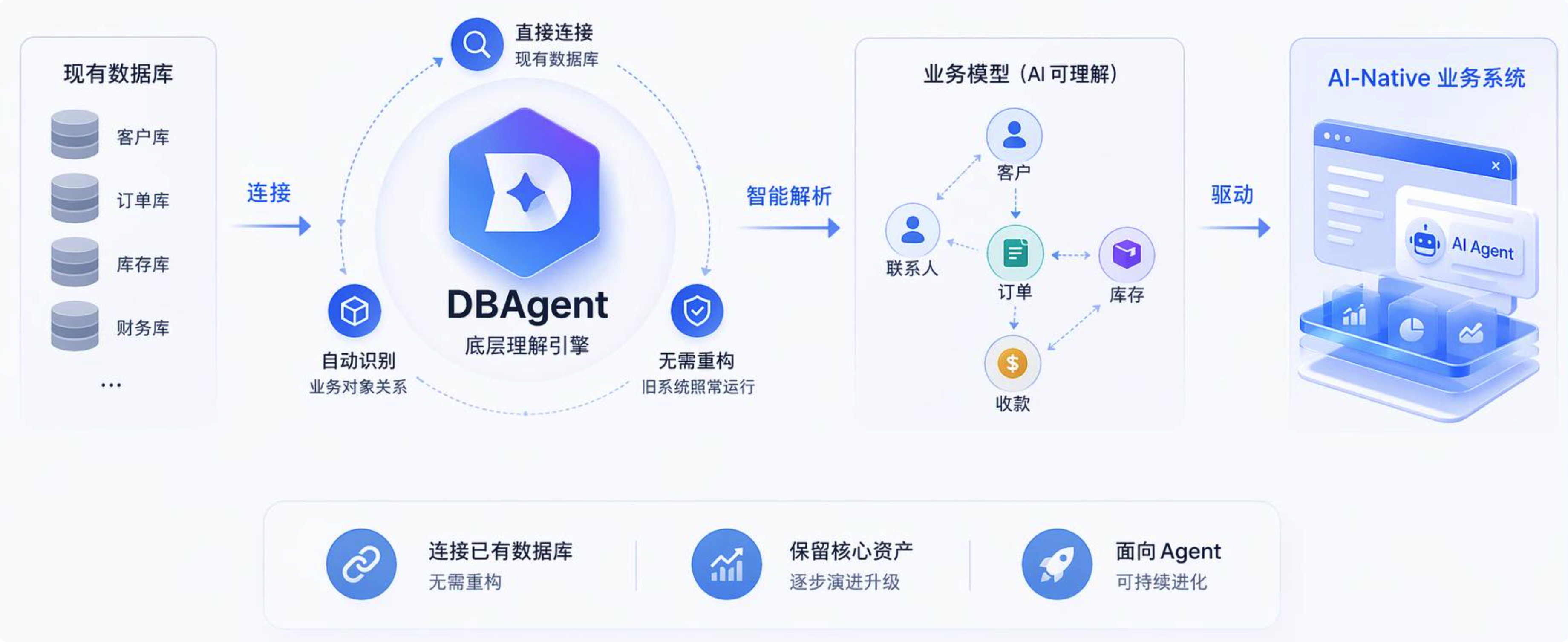
Understand legacy systems from the database
An enterprise's truest, most stable business structure usually already lives in its databases. Business objects — customers, orders, inventory, approvals, finance, projects, opportunities, collections — have long existed as table structures, fields, relationships, SQL, interfaces, and historical data.
Starting from these legacy assets, DBAgent automatically identifies table structures, field meanings, table relationships, business objects, metric definitions, and permission clues — translating physical data structures into business models AI can understand.
The value of this step is low risk and low migration cost: legacy systems keep running, with no upfront re-architecture and no forced replacement.
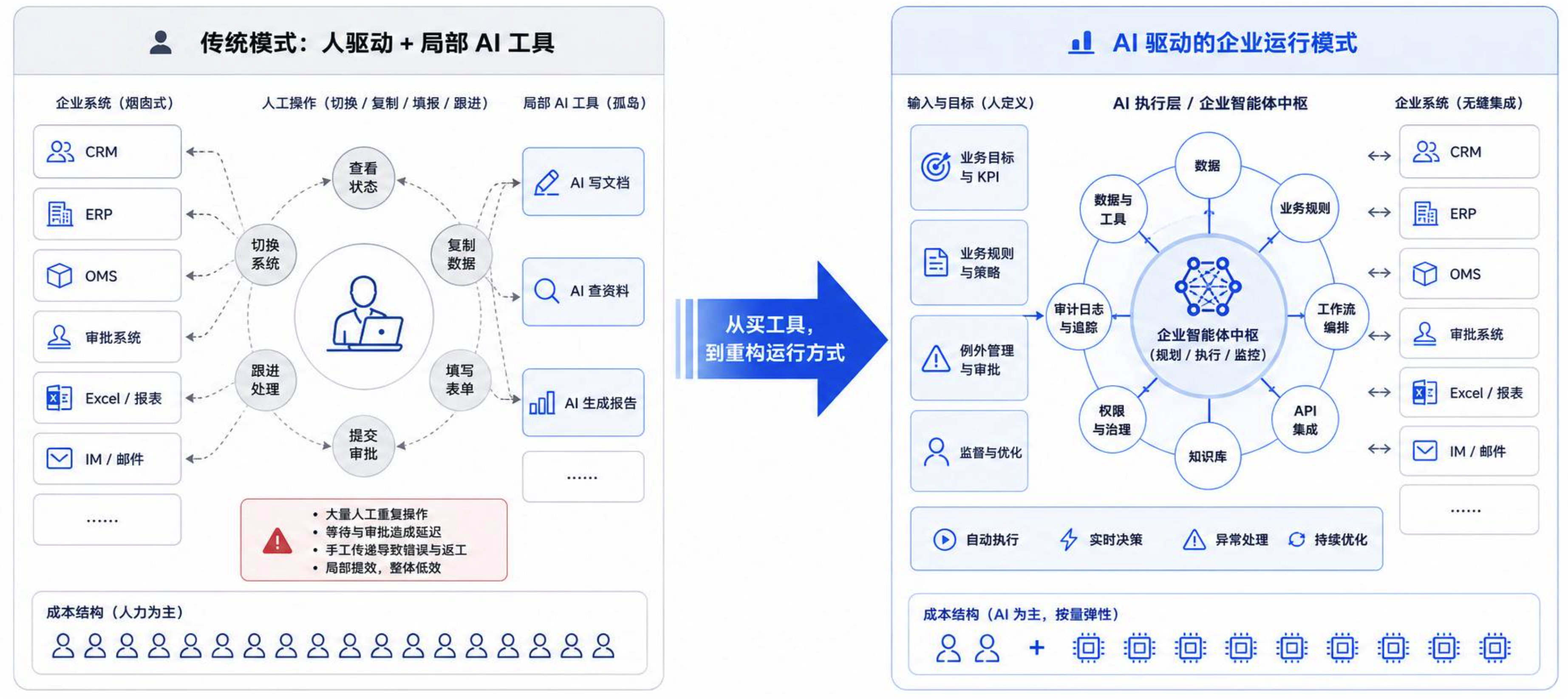
Moving AI from advising to executing
Plenty of AI products can tell business staff what they should do. What enterprises actually need is to get it done.
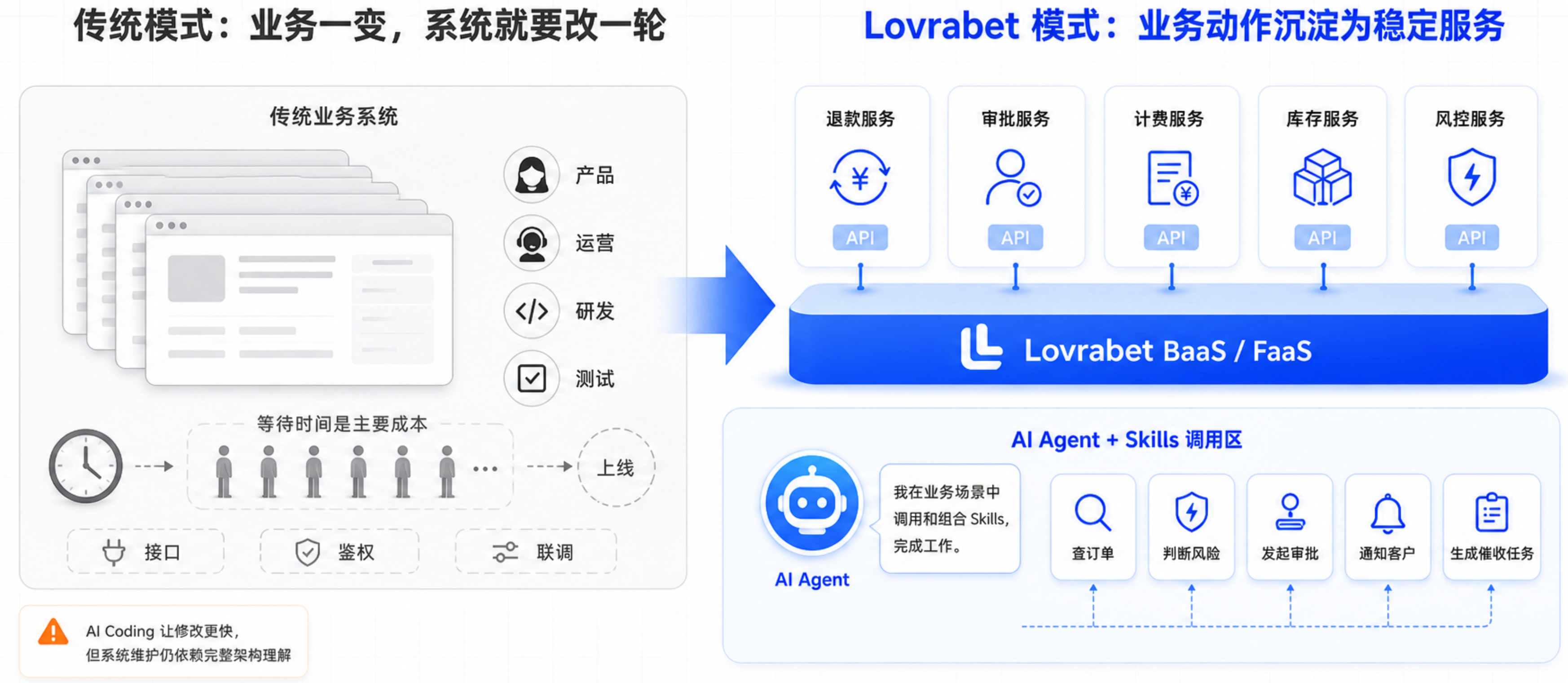
In Lovrabet, once a business user states a goal, the Agent understands the task through the business model and calls authorized data, interfaces, SQL, BFFs, Backend Functions, pages, or CLI tools to complete queries, analysis, validation, process advancement, message syncing, and system write-backs.
Humans keep judgment at the key checkpoints: confirming risks, confirming blast radius, handling exceptions. AI takes on repetitive execution and first-pass analysis; humans own the critical gates and final accountability.
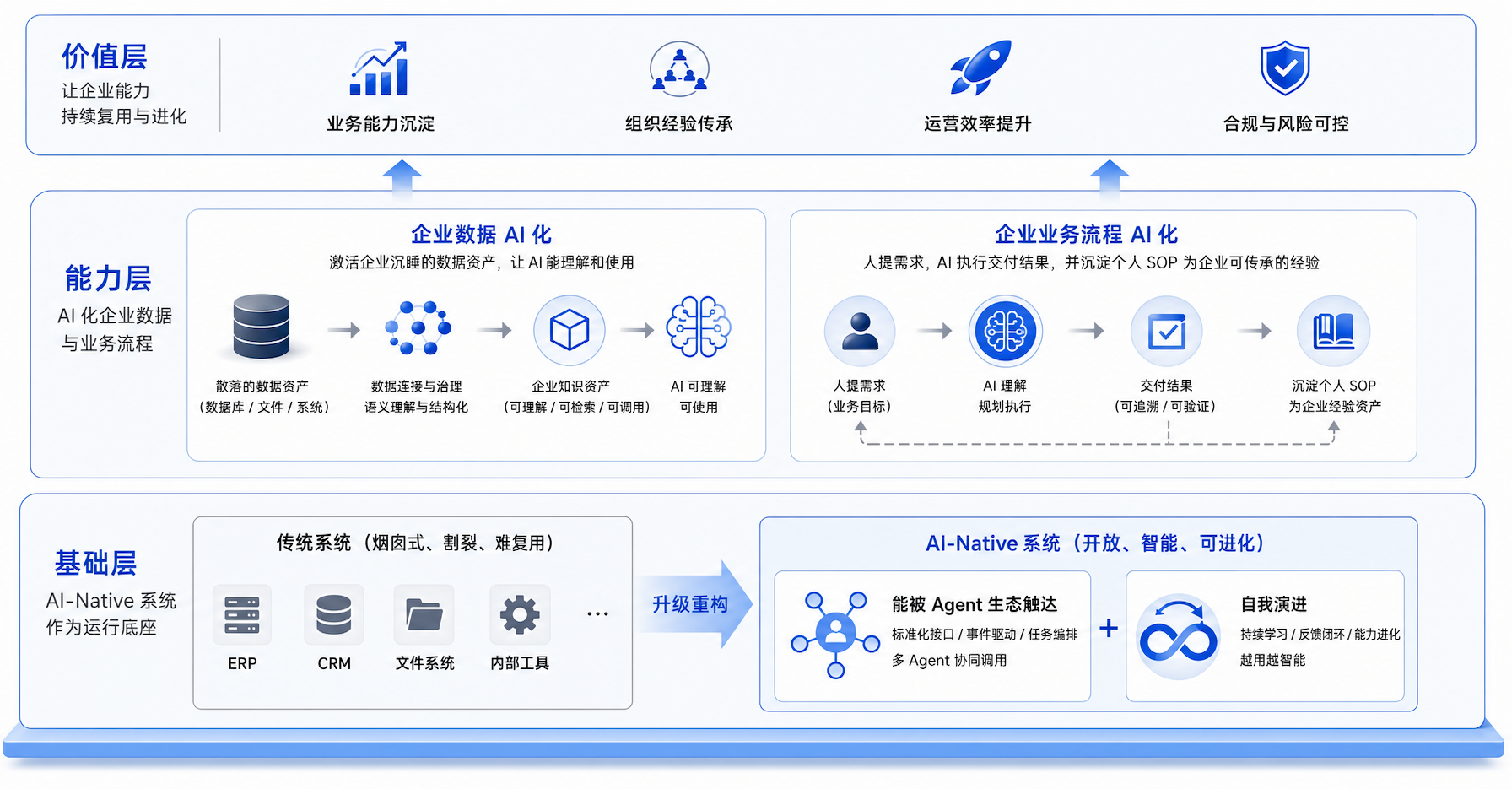
Capturing expert know-how as organizational assets
An enterprise's most valuable assets aren't just data — they're people's judgment, their methods for handling exceptions, their cross-department collaboration paths, and the business SOPs built up over years.
Lovrabet captures the successful paths, course corrections, metric definitions, business rules, and expert judgments from real tasks as Skills, knowledge bases, pages, dashboards, or reusable processes. The next similar task doesn't start from zero: teams reuse proven methods and keep refining them with fresh execution feedback.
The enterprise stops depending entirely on a handful of experts, and the risk of know-how walking out the door with departing staff drops.
Lovrabet's 3 + 1 capability system
| Module | Customer value | Typical outcomes |
|---|---|---|
| 1. DBAgent: a database-driven reverse-engineering engine | Understands the business from existing databases and systems, without tearing anything down | Business models, semantic layer, data relationships, metric definitions |
| 2. Enterprise digital workers: AI executes business processes | Humans state goals; AI runs the process and delivers results | Data Q&A, analysis, validation, process advancement, result write-back |
| 3. Knowledge extraction: continuously capturing expert know-how | Turns successful paths and business SOPs into reusable assets | Skills, knowledge bases, pages, dashboards, team processes |
| +1. Enterprise-grade runtime foundation | Keeps AI execution controllable, auditable, and scalable | Permissions, audit, SQL, BFF, Backend Functions, CLI, SDK |
The first three layers deliver value the business can see; the enterprise-grade foundation makes sure that value survives production.
Product capabilities
TIP
Capabilities at a glance: Lovrabet's capabilities aren't isolated features — they form a complete toolchain that lets the business see value first and keeps engineering controllable for the long run. It starts with "understanding legacy systems," moves into "AI executing business processes, capturing organizational know-how, generating and saving business pages," and lands on "dev-time engineering delivery, AI-friendly interfaces, Backend Functions, and enterprise-grade B2B architecture." Customers can start from a single business scenario and progressively combine data, processes, pages, APIs, functions, CLI, and Skills into their own AI-Native business system. Business users get executable, reusable capabilities first; the technical team then delivers them reliably with Rabetbase-CLI, Instant API, Backend Functions, and the enterprise architecture foundation.
1. DBAgent: understand legacy systems first, then put AI to work
INFO
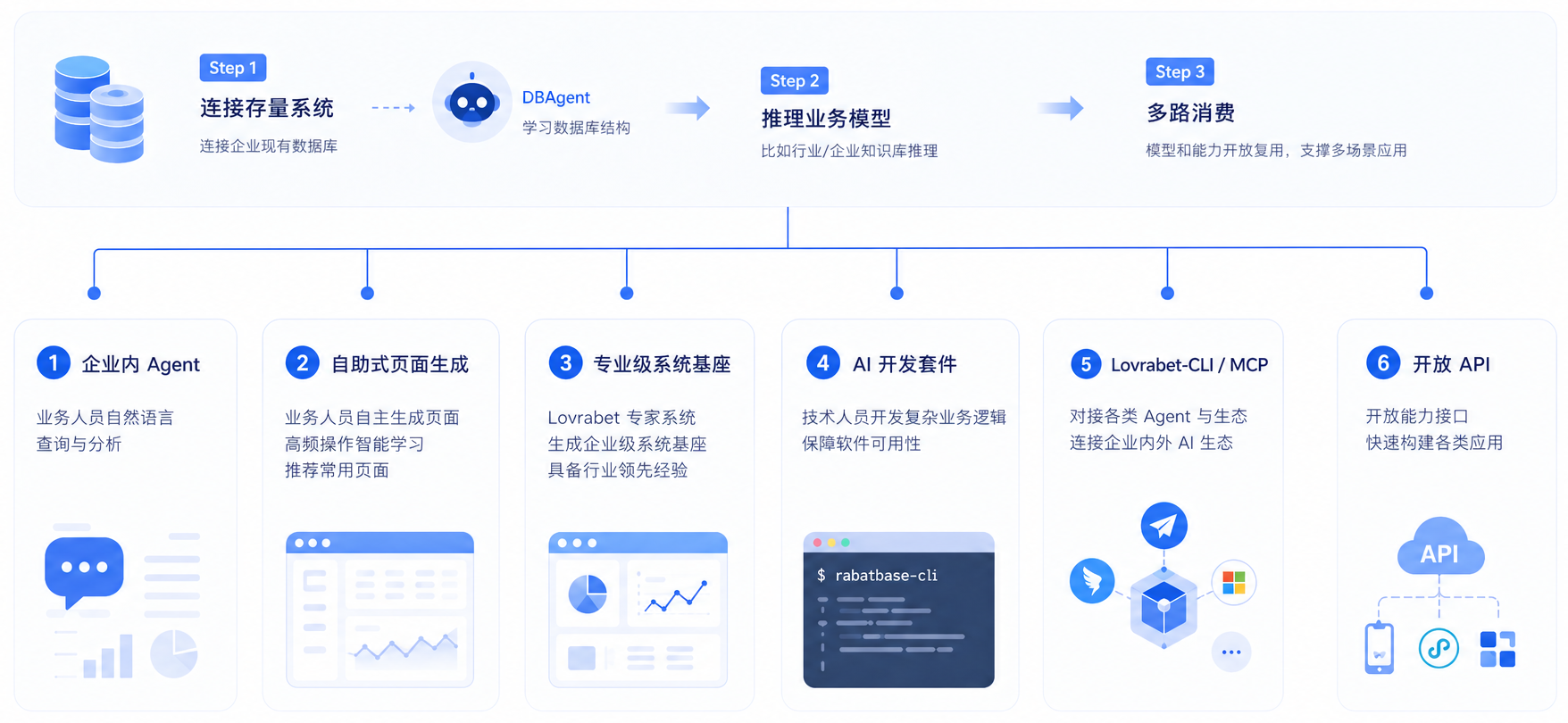
The pain: An enterprise's core business logic often hides in old databases, legacy fields, SQL, and the know-how of a few veteran employees. AI can't plug in — and can't read it. The Lovrabet capability: DBAgent reverse-engineers business objects, relationships, metric definitions, and permission clues from databases and existing systems, upgrading legacy systems into a business foundation Agents can use.
Video demo: an AI-Native business system foundation generated straight from a legacy production database
- No teardown, no big-bang migration — start from the enterprise's most stable layer: the data
- Translate table structures, fields, and relationships into business objects like customers, orders, inventory, and approvals
- One shared business understanding feeds data Q&A, pages, APIs, Skills, and Agent calls
2. Business Agent: not just advice — it actually gets the work done
INFO
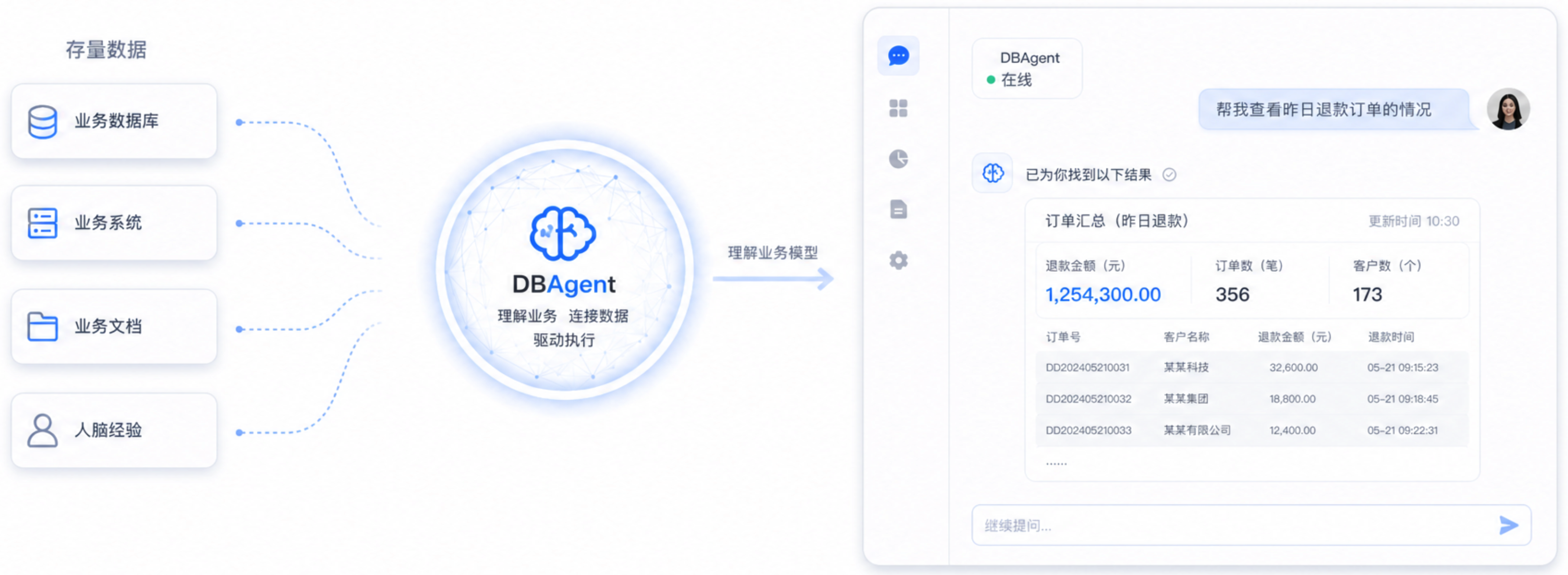
The pain: Ordinary AI can analyze and advise, but when it comes to changing status, starting a process, or writing back to the system, a human still has to switch to the business system and do it by hand. The Lovrabet capability: Runtime Agents call data, interfaces, SQL, BFFs, and Backend Functions within authorized boundaries, turning "suggestions" into "completed business actions."
- Query, analyze, validate, and advance processes around real business objects
- Human confirmation stays at key checkpoints — no black-box automation
- Results write back to the system, leaving an execution trail and a reusable path
3. Lovrabet-CLI: let every role orchestrate its own AI business processes
INFO
Lovrabet provides an open system of CLI, MCP, and OpenAPI interfaces that connects your years of accumulated business data with the AI ecosystem. Business processes run inside clients like WorkBuddy, Trae Work, and Codex App, bringing AI into enterprise business processes end to end.
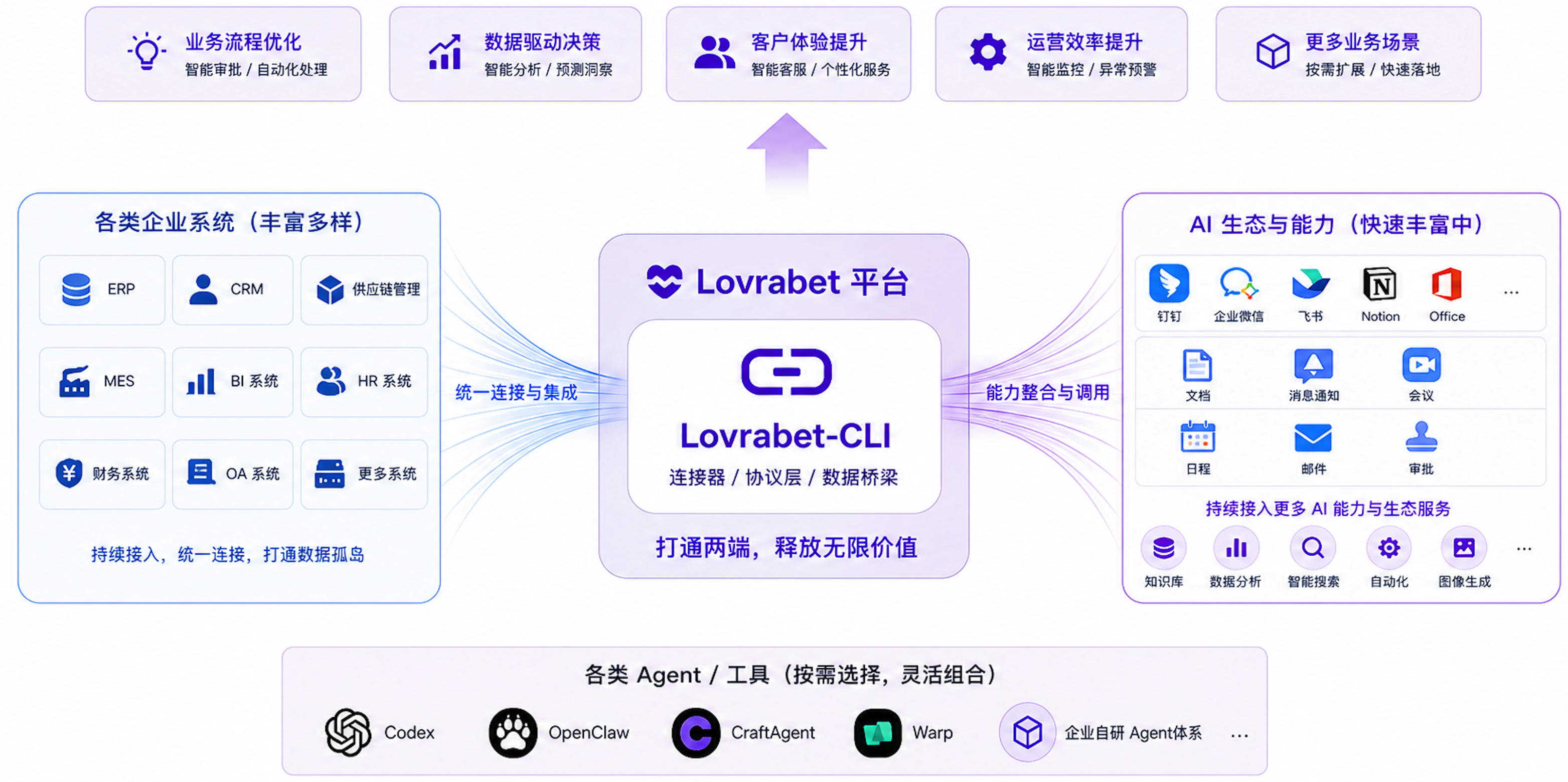
- Run enterprise business processes inside Agent clients like WorkBuddy, Trae Work, and Codex App
- Cross-system queries, analysis, notifications, document preparation, and email delivery
- Turn one-off operations into repeatable, callable processes and Skills
3.1 Video demo: running Lovrabet-built operations in Feishu
3.2 Video demo: accessing the enterprise CRM from WorkBuddy
4. Skills and knowledge bases: keep expert methods in the system, not in people
INFO
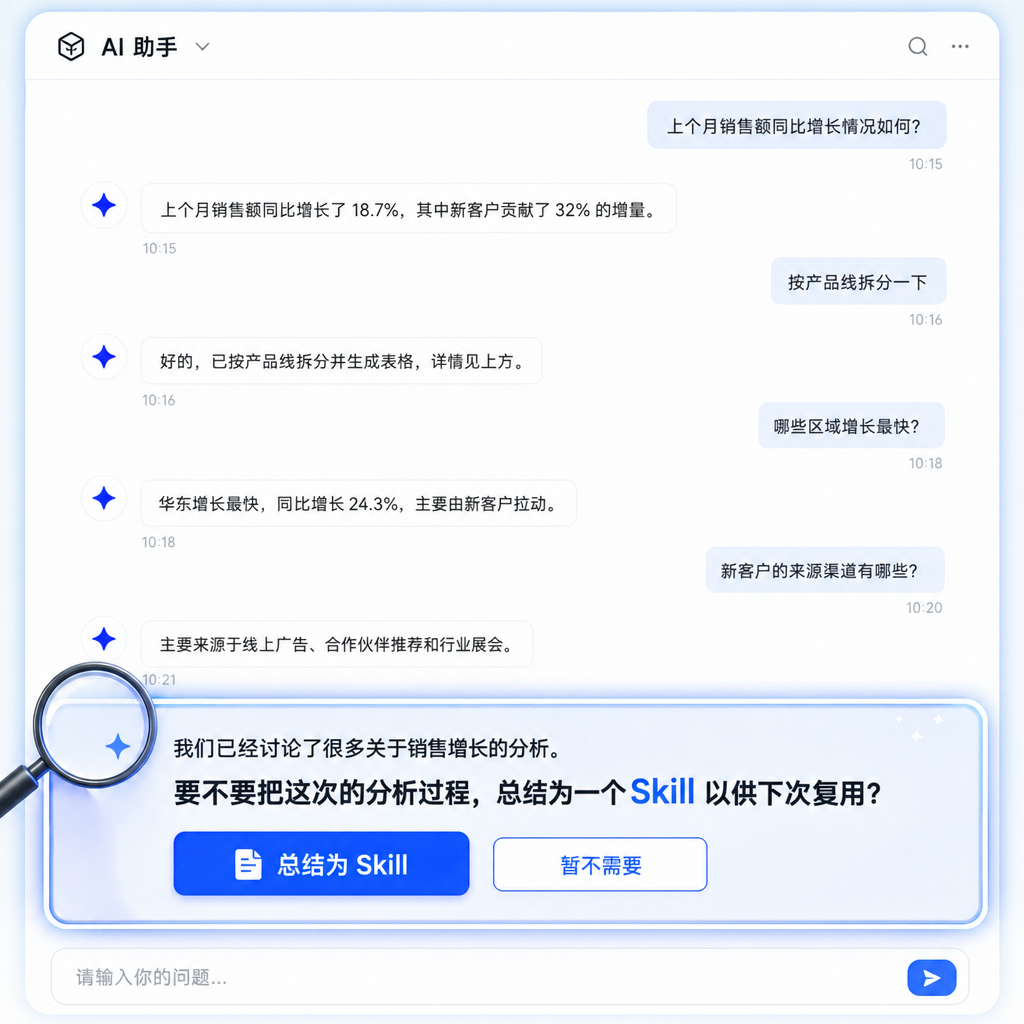
The pain: The hardest thing to copy isn't system features — it's how your best people judge, correct course, and get complex things done. The Lovrabet capability: The system spots stable paths in real executions and, with user confirmation, captures them as Skills, SOPs, and knowledge assets the whole team can reuse next time.
- Identifies stable handling paths from multi-turn conversations, tool calls, and human confirmations
- Valuable-but-tedious procedures trigger a prompt to save them as reusable processes
- Feedback from every reuse keeps calibrating, so organizational capability compounds with use
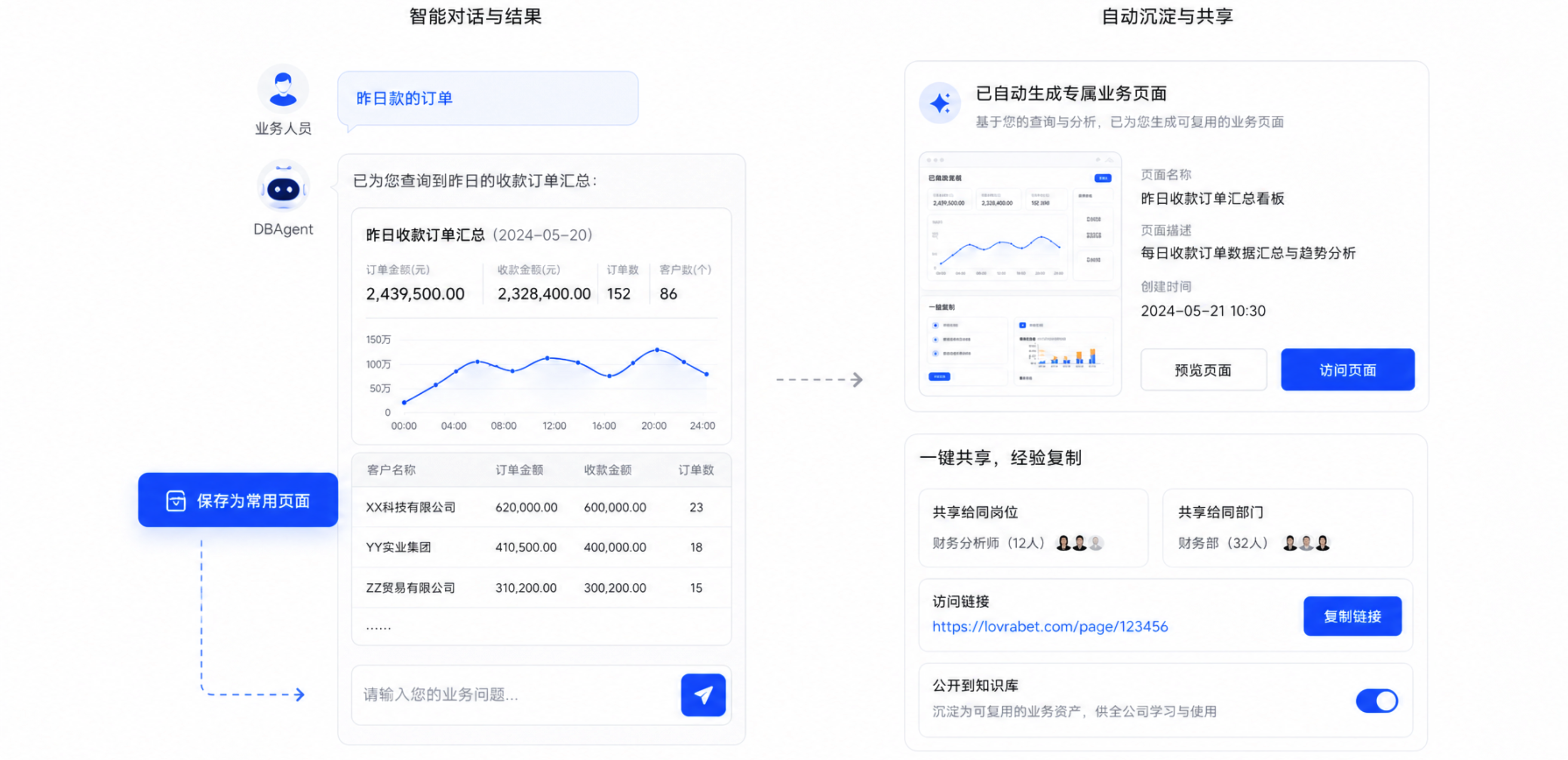
5. Save-as-page: turn one effective run into a team entry point
INFO
The pain: Many one-off analyses, topic dashboards, and process pages start life as a single business task. When they stay trapped in chat logs or screenshots, the team has to ask, query, and re-assemble everything next time. The Lovrabet capability: Once a conversation, query, or execution result proves valuable, business users can save it as a page, dashboard, or team entry point — turning one effective run into a reusable asset.
- Turn ad-hoc analyses, topic dashboards, and process-tracking results into accessible pages
- Pages keep their business context, data definitions, and permission boundaries, ready for direct team reuse
- Real usage feedback keeps feeding back into pages and Skills, so team tools get sharper with use
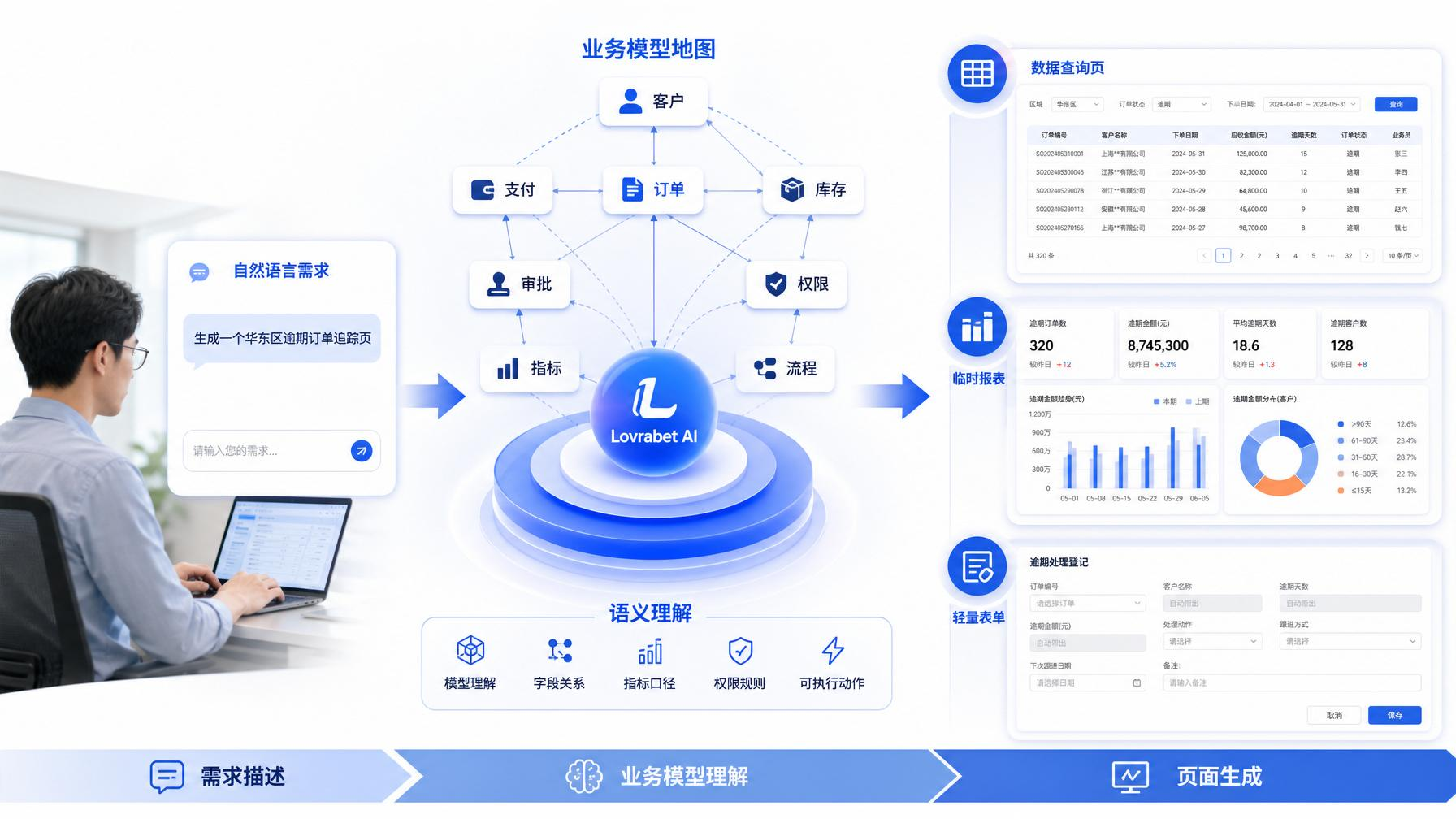
6. Natural-language page generation: describe the task, get the page
INFO
The pain: Business users often need nothing more than a personal query page, a quick report, a light form, or a topic workspace. The traditional route — write requirements, explain fields, sketch prototypes, wait for dev — distorts the need at every handoff. The Lovrabet capability: Business users describe the page they want in plain language. Lovrabet doesn't guess from a blank canvas: working from the business model and model map, it understands the business objects, field relationships, metric definitions, permission boundaries, and executable actions — so generated pages fit the real business.
- One sentence gets you a personal query page, report, quick form, topic dashboard, or process page
- Business objects, fields, filters, action buttons, and permission scopes match automatically — less lost in translation
- Business users iterate and validate ideas fast; the technical team focuses on model governance, component standards, and security boundaries
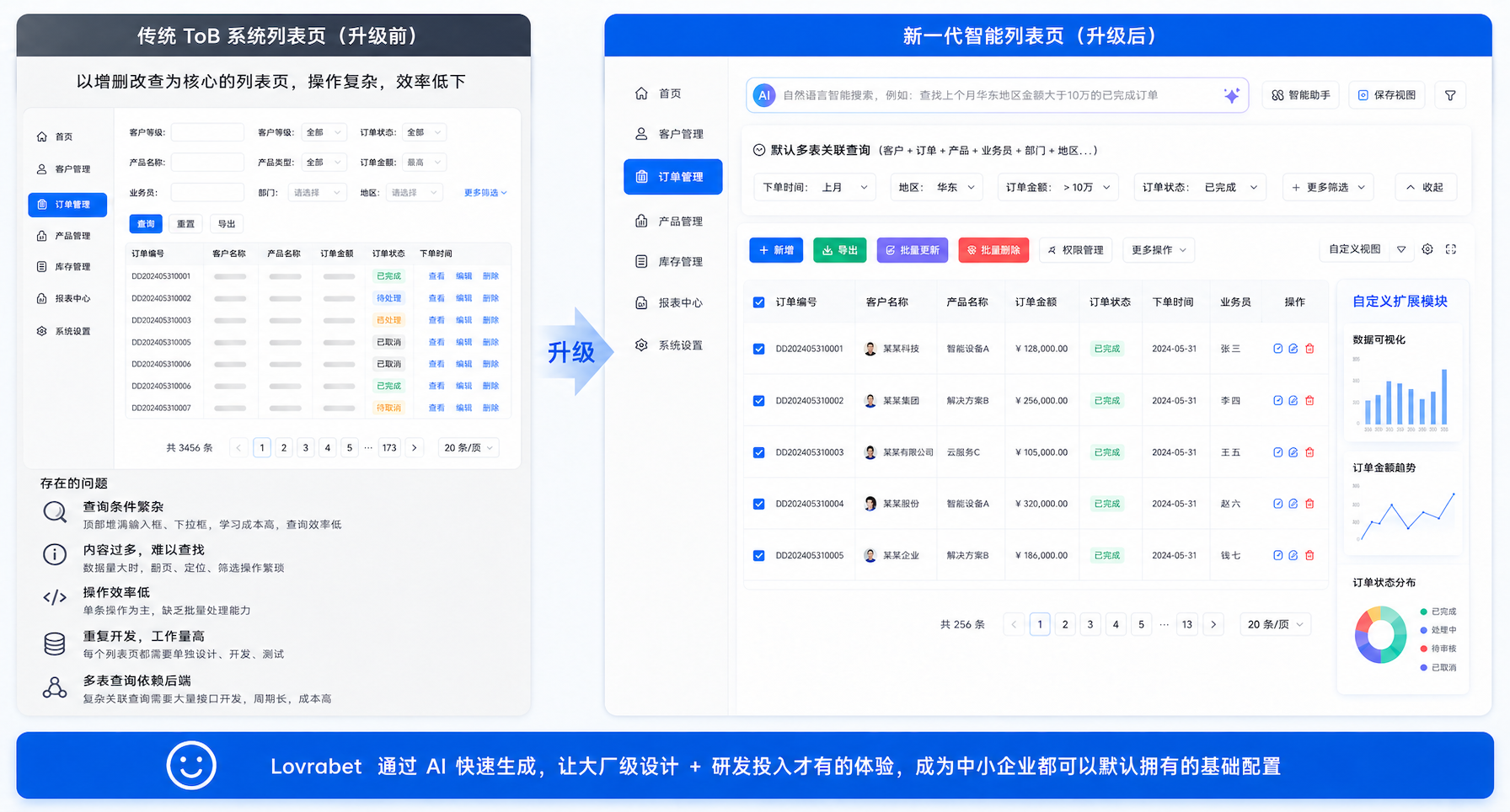
7. SmartList: big-tech-grade B2B list capabilities as the default
INFO
The pain: In B2B systems, most work happens on list pages — query, filter, export, bulk actions, status transitions, access control — and ordinary projects rebuild them from scratch every time. The Lovrabet capability: SmartList auto-generates enterprise-grade list pages around business objects — manageable, analyzable, and executable — so high-frequency capabilities land in the team's toolkit fast.
Video demo: quickly generating a standard business list page (multi-table query by default)
- Built for high-frequency business objects: orders, customers, projects, approvals, inventory
- Smart query, multi-table joins, permissions, bulk actions, export, and reusable views ship by default
- High-frequency conversational needs harden into pages, dashboards, and team entry points
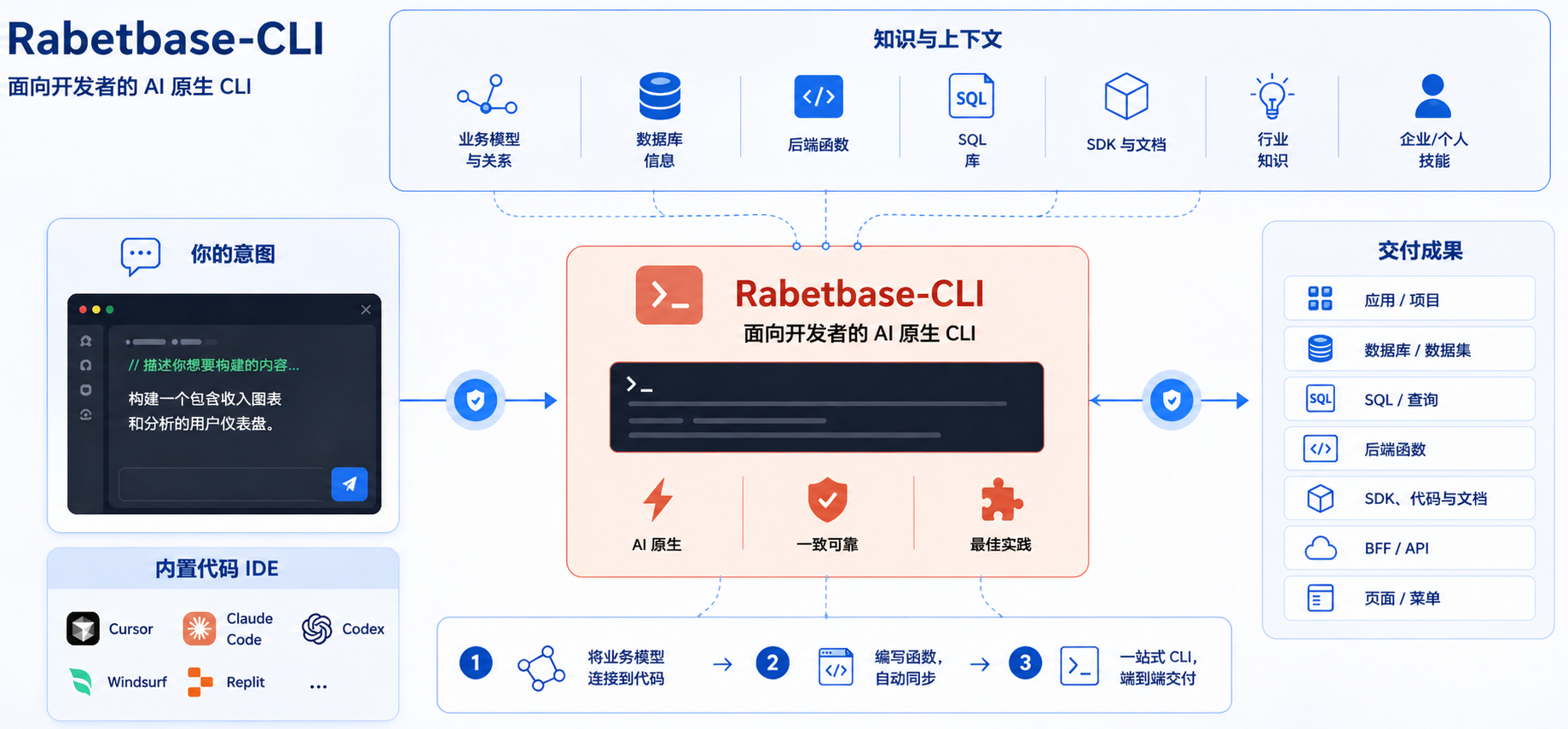
8. Rabetbase-CLI: turn business models into deliverable engineering assets
INFO
The pain: Industry systems carry deeply complex business logic. Without context — business models, database information, Backend Functions, SQL libraries, SDKs, documentation — AI coding easily stalls at "writes code, but doesn't understand business delivery." The Lovrabet capability: Rabetbase-CLI is built for engineers. It connects business models to engineering code, so developers complete database analysis, business modeling, page generation, SQL/BFF development, and release inside Vibe IDEs like Cursor, Claude Code, and Codex.
- Handle 95% of dev-time operations inside your familiar AI coding environment, without constantly returning to the Lovrabet admin console.
- Feed business models, database information, Backend Functions, SQL libraries, SDKs, and documentation into the Agent — fewer hallucinations, less repeated explaining.
- 20+ professional engineering SOPs and 60+ command guides turn database analysis, BFF, SQL, page, and menu delivery into executable procedures.
9. Instant API: turn business models into AI-friendly standard interfaces
INFO
The pain: It's not that enterprises lack data or systems — it's that every time AI or a new app needs to call a business capability, someone re-learns the table relationships, permissions, field semantics, and interface rules. Integration stays expensive and unstable. The Lovrabet capability: Built on the business models and semantics DBAgent parses, Lovrabet auto-generates AI-friendly Instant APIs, so Agents, MCP, Web APIs, OpenAPI, and multi-platform SDKs call enterprise data and business actions in a unified, understandable, governable way.
- APIs generated from business objects and semantics, with multi-table joins and business-metric expressions built in
- Every interface carries permissions, security, documentation, and calling conventions natively — less re-integration, less manual explaining
- Extend complex logic with Backend Functions, forming a stable capability layer of "models + APIs + functions"
10. Backend Function: turn critical business actions into services AI can call safely
INFO
The pain: Writing back orders, triggering approvals, deducting stock, generating invoices — actions like these can't be left to AI improvising interfaces, and certainly not to direct database edits. The Lovrabet capability: The technical team encapsulates critical business actions as Backend Functions, so Agents call stable business services that are authorizable, auditable, and rollback-capable.
- Script names publish directly as callable APIs for pages, Webhooks, Agents, Skills, and CLI
- Supports Before Hooks, After Hooks, transactions, shared logic, and CLI-based publishing
- The team accumulates reusable business services, not throwaway project code
11. Enterprise-grade B2B architecture
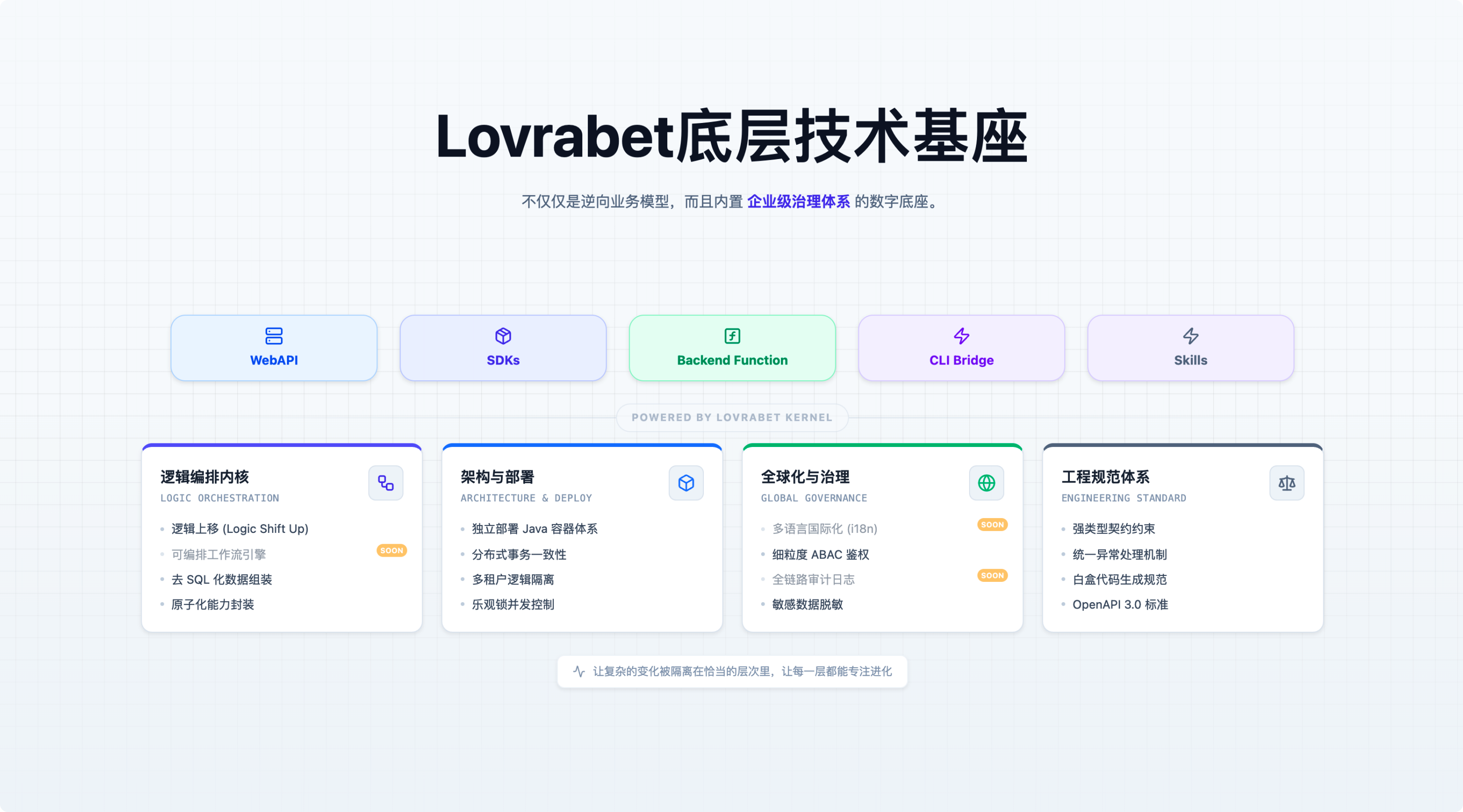
- Logic Shift Up encapsulates complex business logic into atomic capabilities, making business development faster and easier to maintain.
- Independent deployment, distributed transactions for data consistency, multi-tenant logical isolation, and optimistic-locking concurrency control meet demanding enterprise requirements for high availability, high concurrency, and high security.
- Engineering standards safeguard code quality and long-term maintainability. Strongly typed contracts keep interfaces safe; unified exception handling improves robustness.
What changes for business users
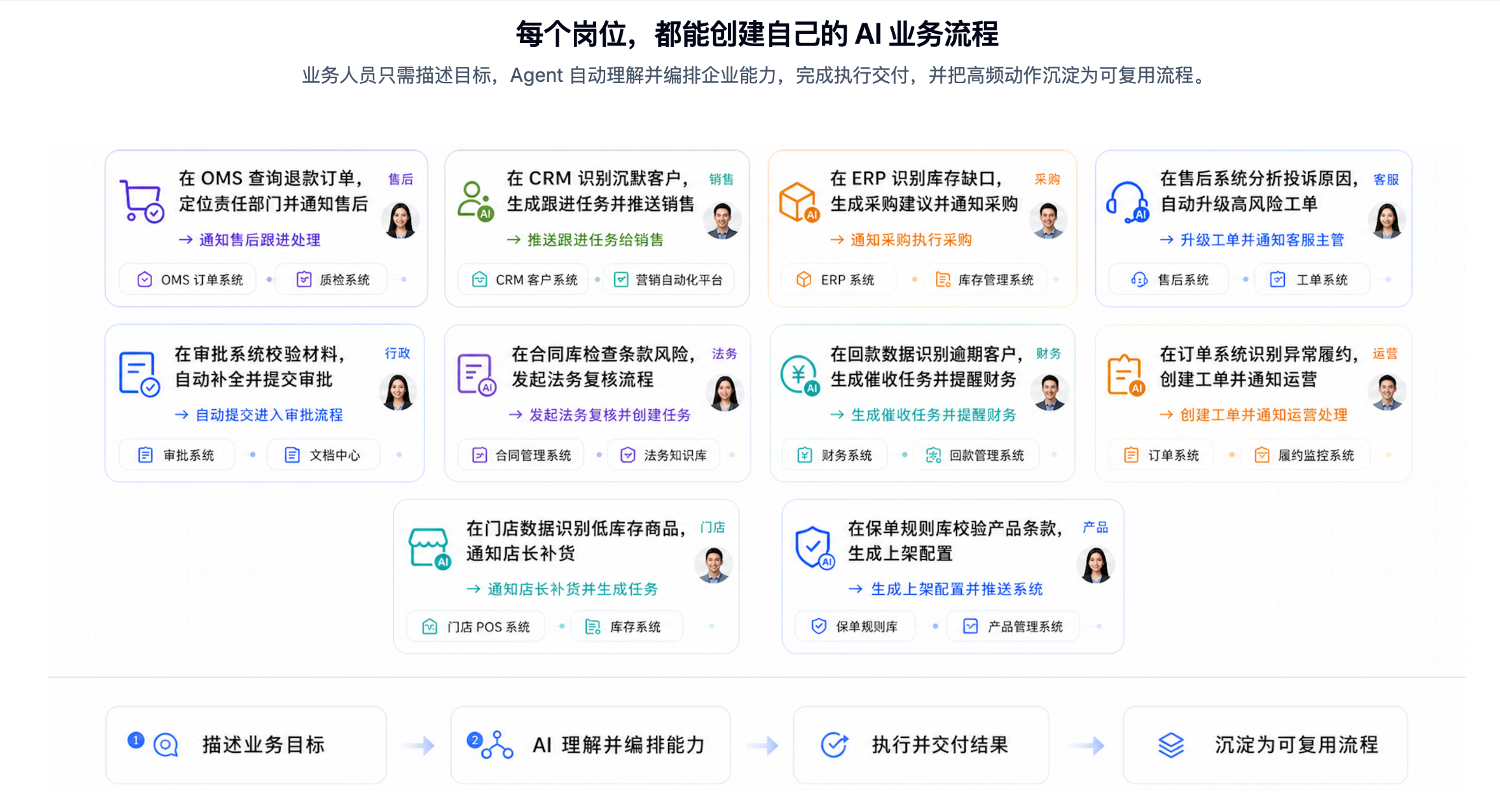
It used to mean hopping between systems all day: pull the data, copy the results, fill in the form, start the approval, notify colleagues, track the status — then write the experience into a doc or lose it in chat history.
With Lovrabet, business users simply state the goal:
- "Find the category with the highest share of quality-related refunds yesterday and brief the quality lead."
- "Generate the launch configuration and validation items from this insurance product's rules."
- "Pull this customer's communication history, orders, collections, and risk points into a follow-up plan."
- "Summarize this week's project delay risks and remind the responsible owners to add reasons."
The Agent doesn't just answer — within the enterprise's authorized boundaries it queries data, analyzes, calls systems, produces results, and advances processes, capturing the stable, proven paths along the way.
What the technical team gains
Lovrabet doesn't bypass the technical team — it amplifies their value.
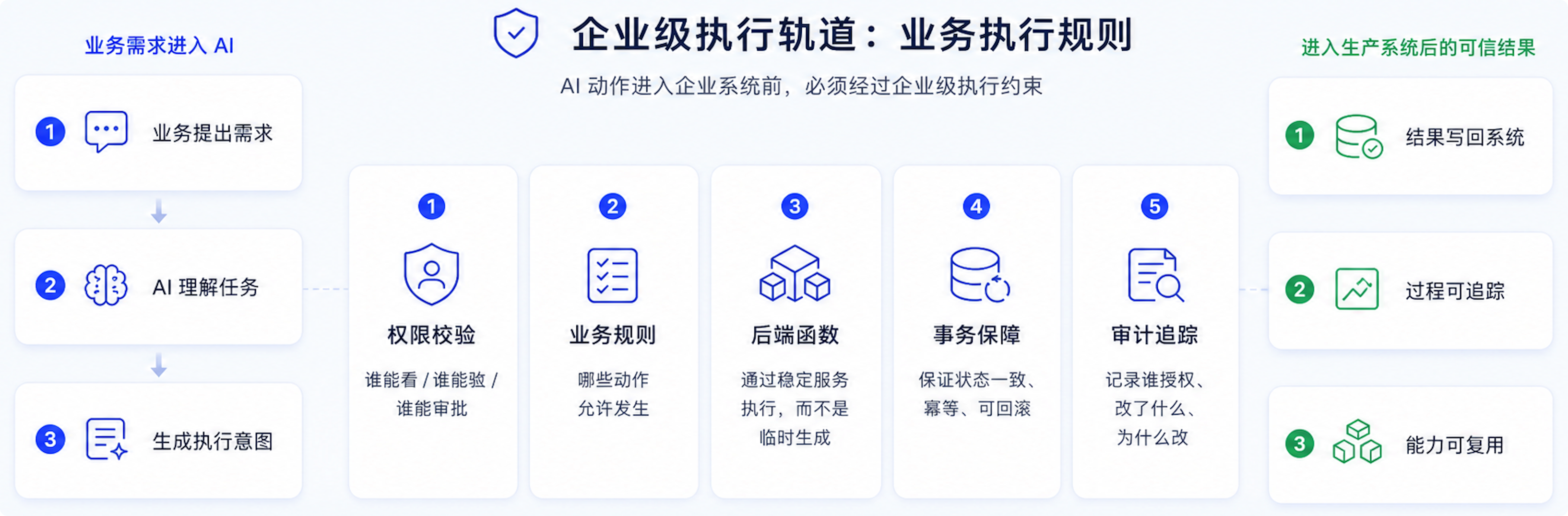
Enterprise-grade business can't run on AI improvising interfaces, patching SQL, and hot-fixing systems each time. Complex business needs stable permissions, audit, transactions, idempotency, state transitions, and engineering boundaries.
With Lovrabet's dev-time capabilities, the technical team encapsulates critical business capabilities into deterministic execution assets:
- Custom SQL to lock in trusted data definitions and metric calculations.
- BFFs to orchestrate interfaces for business scenarios.
- Backend Functions to handle critical actions: write-backs, approvals, inventory, settlement, risk control.
- Rabetbase-CLI to manage database connections, modeling, pages, SQL, BFF, and releases.
- Permissions, audit, and risk gates to keep AI execution under control.
Business users express goals. Agents connect goals to execution assets. The technical team governs the boundaries and accumulates the critical capabilities.
Value for business leaders
For owners and business leaders, Lovrabet isn't just another AI assistant — it makes how the enterprise runs something you can observe, calibrate, and capture.
Leaders used to see only outcome reports, rarely how those outcomes formed: which data the team queried, which definitions they judged by, which processes kept manufacturing inefficiency, which expert methods deserved copying.
Lovrabet leaves these processes a systematic trail:
- See which business objects, metrics, and problems your teams and Agents work around.
- See how your top performers analyze, judge, and execute.
- Capture proven paths as Skills, SOPs, and knowledge assets.
- Check whether organizational execution aligns with business priorities.
- Spot the processes, systems, and collaboration chains that keep creating drag.
That value isn't a prettier report — it's moving the enterprise from "reviewing results" to "observing operations," from "depending on individual experience" to "compounding organizational capability."
Typical deployment scenarios
Legacy system modernization
The old system still runs — but documentation is gone, logic is scattered, and nobody dares touch it. Lovrabet reverse-engineers the business structure from databases and the running system, upgrading legacy assets into business capabilities AI can understand, call, and evolve — without tearing anything down.
AI executes business processes
Business staff stop asking "what does this data look like" and start asking the Agent to run the whole flow: query, root-cause, generate materials, notify stakeholders, write back to the business system — with human confirmation at the key checkpoints.
Turning organizational know-how into assets
The judgment paths of top performers, experts' hard-won experience, and the SOPs teams run every day no longer live only in heads, chats, and scratch docs — they become Skills, knowledge bases, and reusable processes.
Upgrade ISV delivery
Software vendors stop delivering pages, interfaces, and reports from zero on every project. They capture industry know-how, customer scenarios, data definitions, and business actions as industry Agents, Skills, functions, and templates — moving from project delivery to asset delivery.
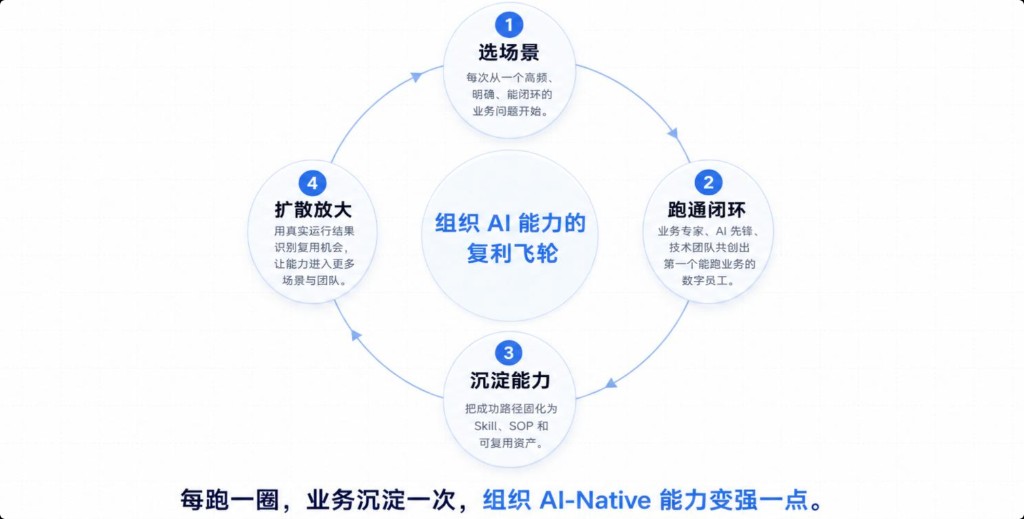
How to get started
Adopting Lovrabet doesn't require a big-bang start. The better way is to begin with one high-frequency, well-defined business scenario that can close the loop:
- Pick one real business problem — refund root-cause analysis, insurance product launch, customer follow-up, project risk, operations analysis.
- Connect the one legacy system, database, or set of business tables that matters most.
- Build the first version of the business model and semantic layer with DBAgent.
- Run one real execution loop end to end: data Q&A, analysis, validation, write-back or delivery.
- Capture the successful path as a Skill, page, report, or Backend Function.
- Use real results to expand to more teams and scenarios.
Every loop captures more business know-how, and the organization's AI-Native capability grows a little stronger.
The bottom line
In the AI era, what separates enterprises isn't just model capability — it's whether the foundation is AI-Native.
Lovrabet's value isn't shipping a traditional record-keeping system faster. It's turning the data, processes, systems, and experience an enterprise already has into capabilities AI can understand, execute, capture, reuse, and keep evolving.
Legacy systems aren't baggage — they're the most authentic starting point for an AI-Native enterprise. Human experience doesn't have to stay in human heads; it can become an organizational asset. AI shouldn't just advise — it should take part in running the business within controlled boundaries.
INFO
The verdict: The upgrade Lovrabet helps enterprises complete isn't delivering traditional systems faster — it's making enterprise systems genuinely AI-Native. Legacy systems aren't baggage; they're the most authentic starting point for an AI-Native enterprise. Human experience doesn't have to stay in heads — it can become organizational assets.