What is RabetBase, and how does it relate to Lovrabet?
Lovrabet serves business users and developers alike: a complete platform for generating AI-Native business systems.
RabetBase is the enterprise-grade intelligent foundation of Lovrabet. Downward, it carries the fundamental capabilities an enterprise needs to run; upward, it supports business apps, industry solutions, and custom extensions. For an enterprise, it is a foundational capability layer that unifies security, process, data, interfaces, and intelligence.
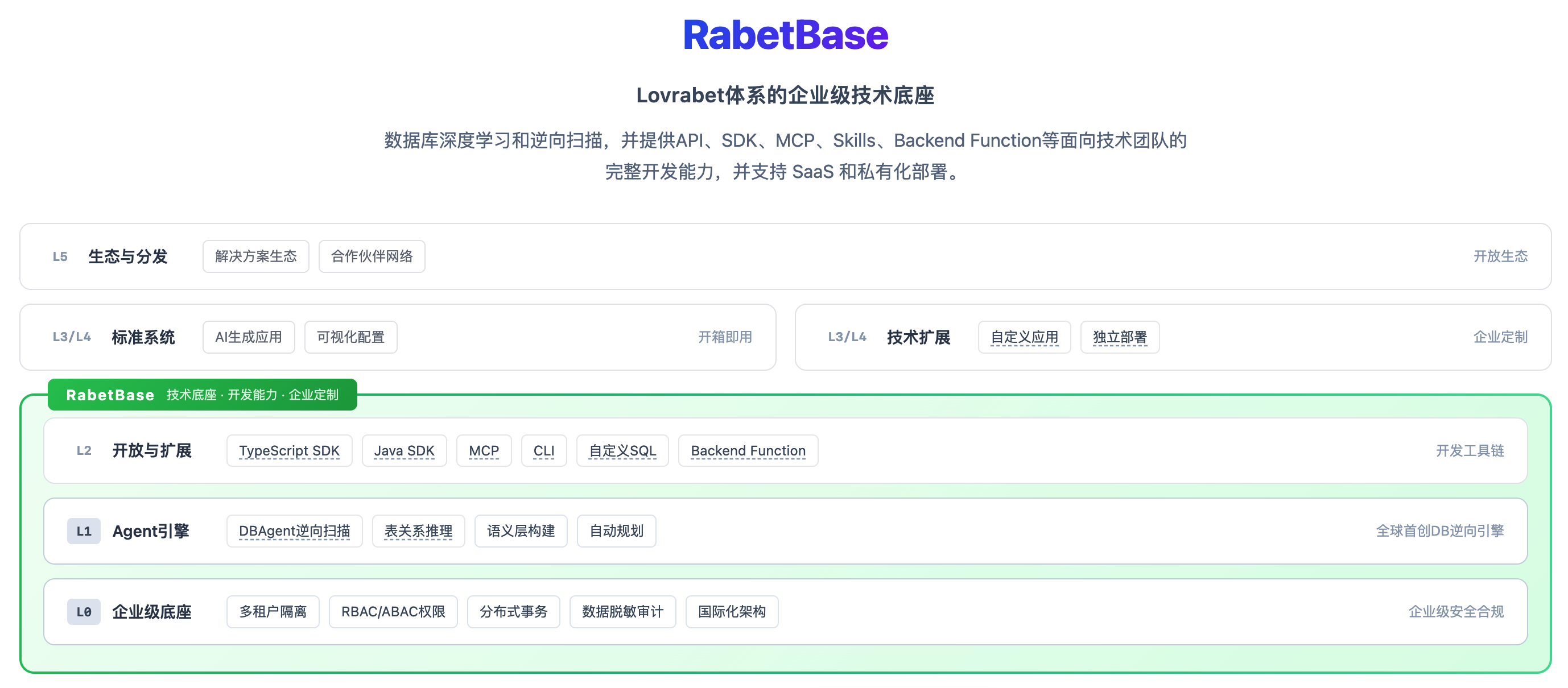
<grid> <column width-ratio="0.500000">
INFO
Lovrabet platform
- AI-Native business system generation
- DB Agent / Vibe Coding / build systems from requirement descriptions
- Workbench / permission management
- Runtime hosting
</column> <column width-ratio="0.500000">
INFO
Rabetbase development system — part of the Lovrabet platform
- CLI: terminal tooling
- SDK: data access interfaces
- Skill: AI-assisted development
- BaaS: Backend as a Service
</column> </grid>
Its point isn't merely to get a system "stood up" — it gives the system a governable, extensible, integration-ready foundation that can keep evolving, from day one. When the enterprise adds new business scenarios, connects upstream and downstream systems, or brings in new AI capabilities, it extends on the existing foundation instead of tearing systems down and rebuilding.
From a capability standpoint, RabetBase anchors enterprise-grade infrastructure on one side — security, permissions, workflows, data governance, and runtime support — and offers open extensibility on the other, so enterprises keep building apps unique to their own business instead of being locked into a fixed template. The foundation owns stability and consistency; the apps own business fit and change. That clear division of labor is exactly what lets enterprise systems evolve over the long term.
RabetBase: not another system — lay the enterprise digital foundation first
As enterprises push digitalization forward, the first pain they feel usually isn't "we can't build the features" — it's that every system they build means rebuilding the underlying capabilities all over again.
Permissions get redesigned, processes re-mapped, data definitions re-unified, and inter-system interfaces re-wired. Projects go live one after another, yet the problems never really shrink — they get more tangled as systems multiply. On the surface, the enterprise owns more and more tools; over time, maintenance, coordination, and upgrade costs climb right alongside.
RabetBase set out to solve exactly this class of problems. It isn't a single-point feature or an isolated module — it's a digital foundation built for the enterprise. The capabilities every system inevitably needs, yet every project ends up rebuilding, are consolidated up front into one unified foundation, so new business apps no longer start from zero: they grow on top of a mature, stable, extensible capability system.
In this sense, RabetBase works like the "business chassis" of enterprise digitalization. Standard capabilities get reused, custom needs get extended, and systems keep evolving with organizational, process, and business change after launch — instead of growing heavier and harder to modify with every iteration.
What enterprises really lack isn't more systems — it's a unified foundation
At a certain stage, most digitalizing enterprises hit the same wall: systems keep multiplying, while the shared capabilities actually being consolidated keep shrinking. Departments run different processes, systems carry different permission models, and businesses hold different data standards. Every new app piles another layer of complexity onto an already complex environment.
That's why what enterprises need for the long run has never been "one more system" — it's a foundation they can reuse again and again. Only on a stable foundation can the app layer grow fast; only on a unified one can data, processes, and permissions truly work together; only on an extensible one can the enterprise face new business, new organizational shapes, and new technology without tearing everything down and starting over.
The value of RabetBase lies in getting this layer right first. It doesn't add another burden — it takes over, in one place, the capabilities that must exist anyway but shouldn't be rebuilt project after project.
Development toolchain
To help developers use these capabilities efficiently, RabetBase consolidates everyday development work into a durable toolchain. The entries below are organized by use case:
| Toolchain | Primary use case | What it solves | Documentation |
|---|---|---|---|
| Rabetbase CLI | AI Coding development suite | Lets agents such as Codex, Claude Code, and Cursor read Lovrabet app context and keep developing pages, datasets, SQL, Backend Functions, and menus. | Usage guide · 5-minute quick start |
| TypeScript SDK | Web / mini-program / Node.js integration | Query, write, aggregate, paginate, and filter across tables on real business models — less field guessing and repeated wrapper code. | SDK docs · Filter API · Multi-table queries |
| Java SDK | Enterprise backends and system integration | Bring Lovrabet data, actions, and authorization into Spring Boot, microservices, batch processing, and external systems. | Java SDK · Examples |
| Backend Function | Backend business actions | Encapsulate approvals, state transitions, batch processing, cross-table transactions, and external API calls into stable services. | Usage docs · Standalone endpoints · Common functions |
| Custom SQL | Metrics, reports, and complex queries | Consolidate complex filters, fixed statistical definitions, cross-table queries, and reusable report logic. | Docs · Local development tutorial |
| OpenAPI / Instant API | External systems and client access | Open business data and platform capabilities to mini-programs, apps, third-party systems, and automation via standard HTTP interfaces or Instant API. | OpenAPI · Instant API |
| Standalone deployment | Enterprise intranets and private delivery | Run the finished business system independently, inside the enterprise's own data-security boundary. | Deployment guide |
The MCP Server is now covered by the Rabetbase CLI / Skill system — for new development integrations, use the Rabetbase CLI.
Closing thoughts
Enterprise digitalization today is no longer just about shipping "a system" — it's about building a capability foundation that can absorb business change for years. Systems can go live one by one, but what really determines future efficiency and cost is whether underlying capabilities are reusable, whether the architecture can extend, and whether complexity is kept in check.
What RabetBase does is get this foundation solid first. It standardizes common capabilities and maximizes the speed of core business innovation, so standard systems ship faster, custom capabilities keep growing, and the enterprise always has a stable, reliable, extensible starting point — no matter how business change, organizational upgrades, and AI opportunities stack up.
Docs library navigation
- Developer docs navigation by category (auto-curated): RabetBase developer docs navigation (auto-generated)
- Last updated: 2026-04-16