TIP
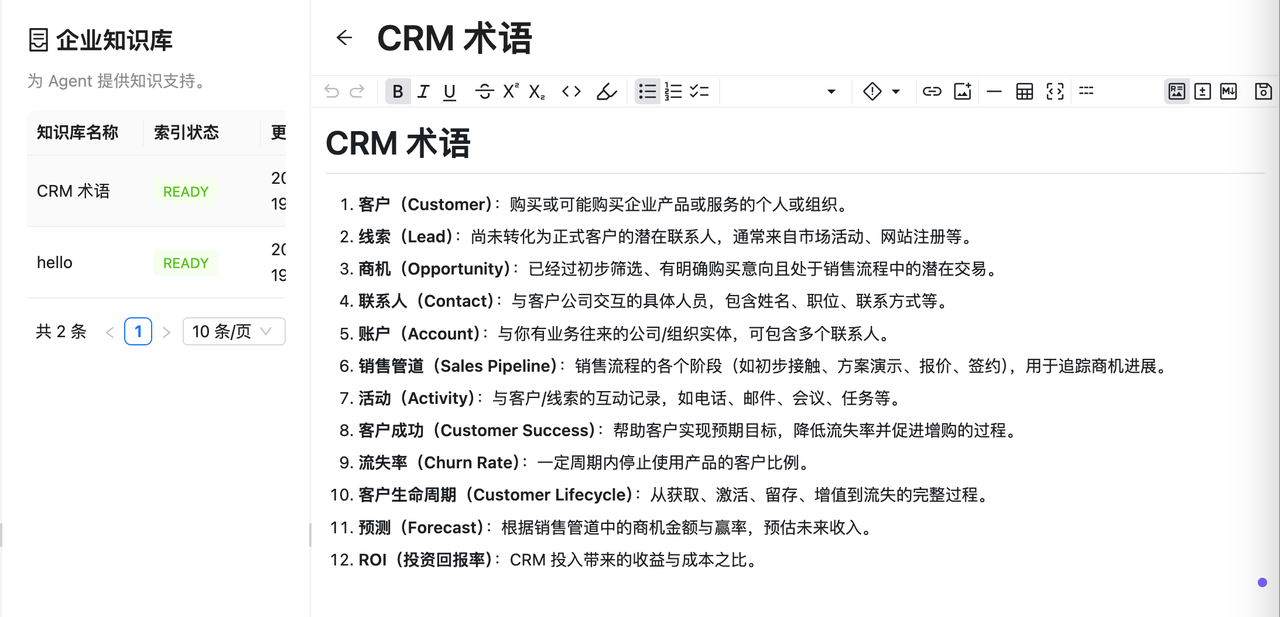
The knowledge base holds the business background Lovrabet Agents rely on. It stores enterprise-wide rules and individual know-how in separate layers, so the Agent works from one set of confirmed field definitions, calculation rules, and SOPs whether it is querying system data, analyzing root causes, or executing tasks.
Who this is for
| Role | What they care about |
|---|---|
| App administrators | Maintain shared enterprise knowledge so the team and the Agent use one business vocabulary. |
| Business owners | Capture approval rules, calculation rules, handling SOPs, and common cases. |
| Business users | Save personal notes, scope of responsibility, and output preferences as personal knowledge for later conversations. |
| Implementation and delivery staff | Turn customer business material into knowledge the Agent can search and cite. |
What the knowledge base is
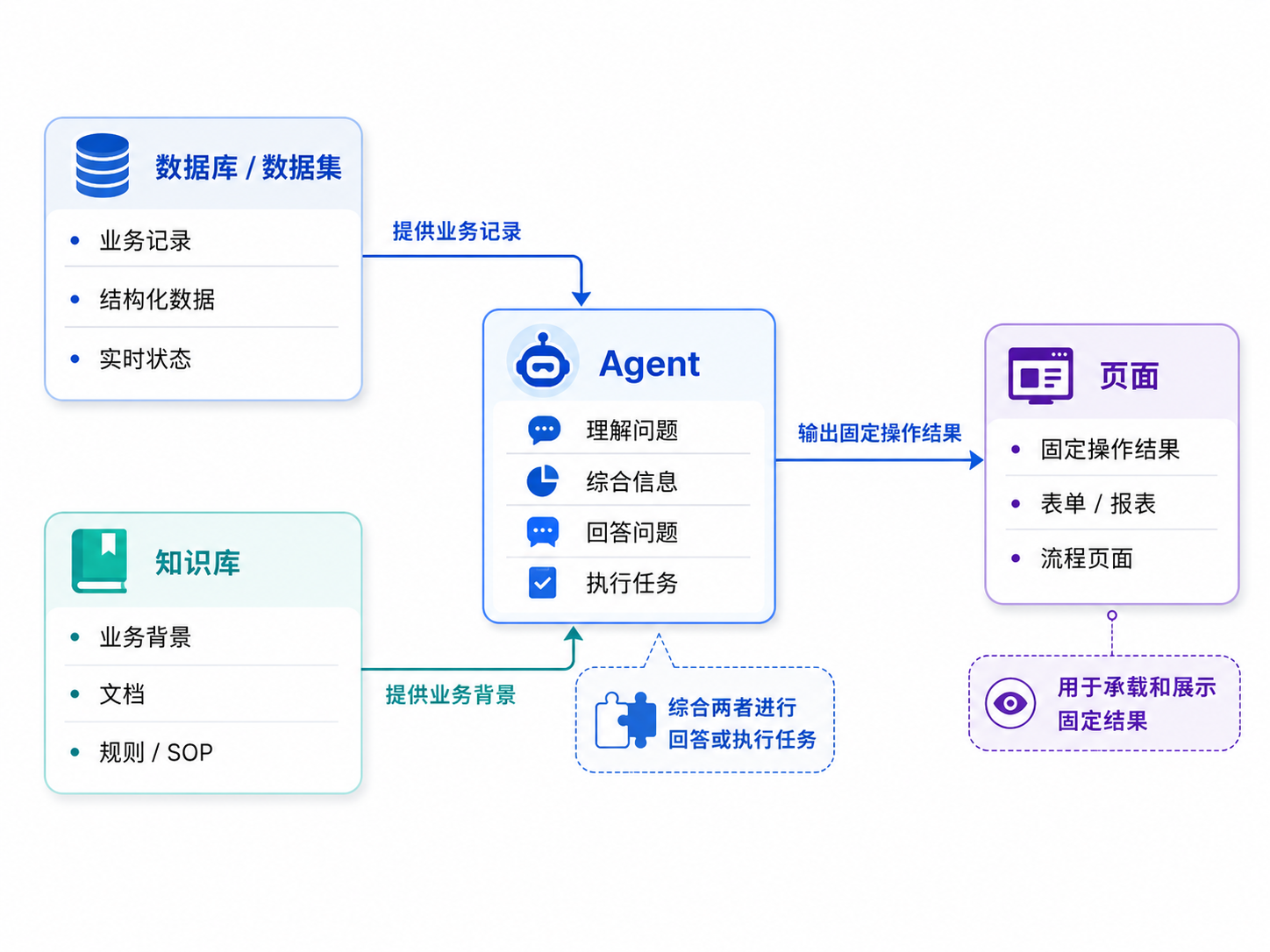
A knowledge base stores the background needed to interpret business data and business actions. It doesn't replace the database, and it doesn't replace pages.
| Content | Where it lives | How the Agent uses it |
|---|---|---|
| Business data such as customers, orders, contracts, and approval records | Databases and datasets | Queries real records per permissions |
| Field definitions, calculation rules, handling SOPs, case templates | Knowledge base | Business context for answering and handling tasks |
| Frequently visited lists, forms, and reports | Pages | Host fixed business operations and display results |
Enterprise knowledge and personal knowledge
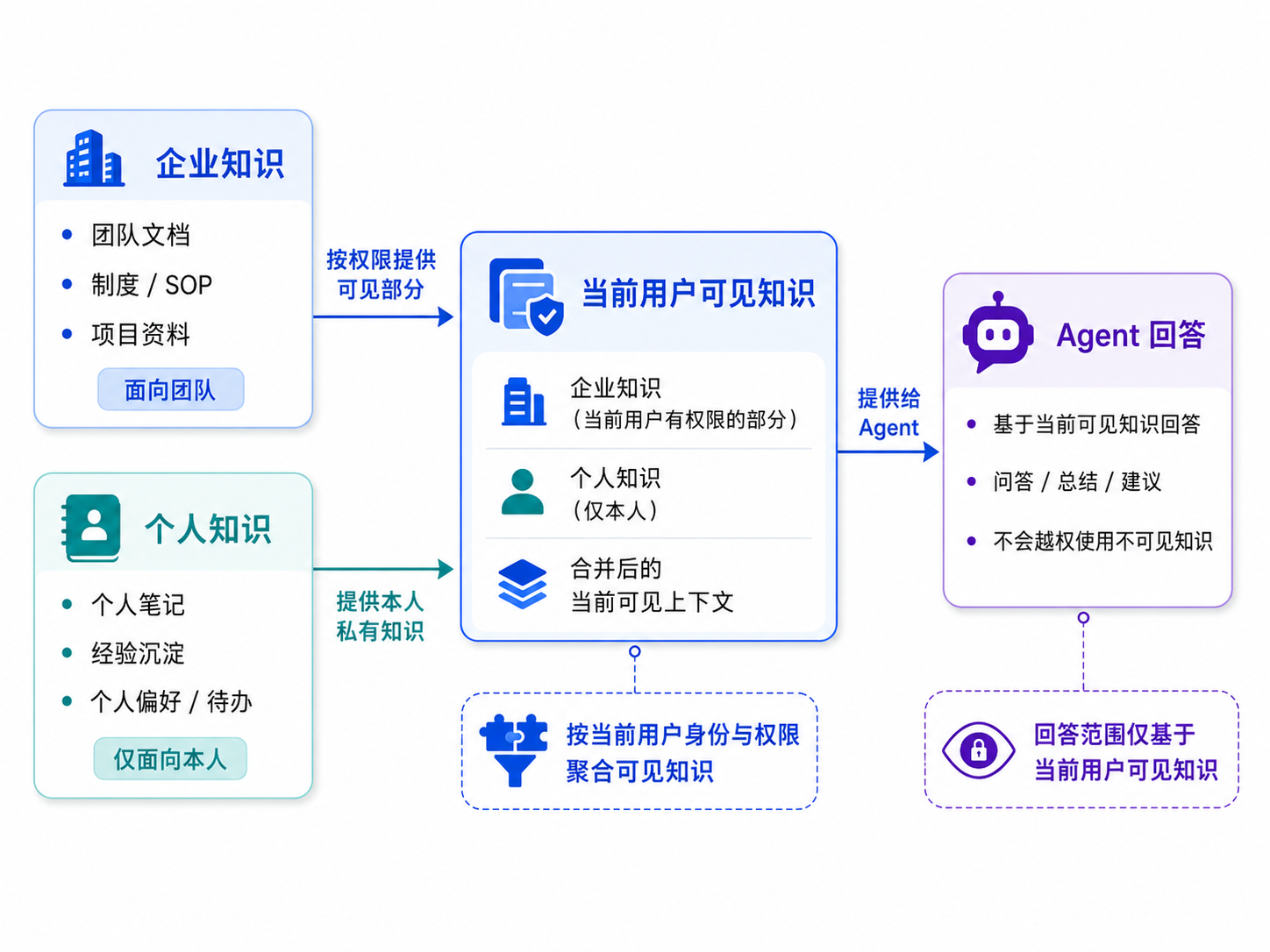
The knowledge base has two layers: enterprise knowledge keeps the team aligned; personal knowledge is for individual additions. Both live within the current app, but they differ in visibility and maintenance.
| Layer | Maintained by | Best for | Who can use it |
|---|---|---|---|
| Enterprise knowledge | App administrators, business owners, implementation and delivery staff | Team-wide field definitions, calculation rules, business SOPs, product notes, standard templates | Users with permission in the current app, and Agents |
| Personal knowledge | The user, or an Agent writing with the user's confirmation | Personal scope of responsibility, favorite query conditions, output preferences, temporary but reusable experience | The user and the Agents serving that user |
How the two layers work together
- Put anything the whole team must agree on into enterprise knowledge first.
- Then put personal scope and preferences into personal knowledge.
- When answering a question, the Agent first understands the current app and user, then searches the knowledge visible to them.
- If personal and enterprise knowledge conflict, fix the enterprise knowledge first so team results stay consistent.
WARNING
Enterprise knowledge is not a dumping ground for everything. Only confirmed content that the team will reuse and that affects the Agent's judgment belongs there.
What belongs in it
| Content type | Examples | Recommended layer |
|---|---|---|
| Field definitions | Business meaning of customer tier, order status, approval status, follow-up stage | Enterprise |
| Calculation rules | What counts toward deal revenue, active-customer criteria, how overdue days are computed | Enterprise |
| Business SOPs | Exception-order handling, refund approval rules, customer follow-up guidelines | Enterprise |
| Team background | Region mapping, product line notes, ownership split, how known issues are handled | Enterprise |
| Personal scope | "I own the East China region", "I focus on renewal customers", "I usually look at the last 30 days" | Personal |
| Personal output preferences | Daily reports sorted by risk, conclusions before details, amounts shown in 10k units | Personal |
What doesn't belong
- AccessKeys, cookies, account passwords, secrets.
- Customer PII, sensitive contract terms, internal material not cleared for sharing.
- Throwaway debug logs, one-off errors, unconfirmed guesses.
- Business detail data that needs real-time updates — that belongs in databases and datasets.
Using it inside an app
| Entry point | What you do | Typical result |
|---|---|---|
| App management | Maintain enterprise knowledge in the AI Asset Center | Team rules, field definitions, and SOPs are managed in one place |
| Agent conversations | Have the Agent query data, analyze causes, and handle tasks with the knowledge base | Answers draw on the captured business background |
| Agent-saved knowledge | Save confirmed information from a conversation as personal knowledge | That personal experience carries into later conversations |
| CLI / external Agents | Maintain personal knowledge and search visible knowledge from external Agents, scripts, or automation | External tools and Lovrabet apps share one set of knowledge |
How it differs from Skills and Rules
Knowledge, Skills, and Rules all shape the Agent, but each solves a different problem.
| Asset | What it does | Quick rule of thumb |
|---|---|---|
| Knowledge | Supplies facts, rules, field definitions, SOPs, and case background | If the Agent needs to "know" something, put it in the knowledge base. |
| Skill | Defines how a class of tasks runs — steps, tool permissions | If the Agent needs to "do" something, put it in a Skill. |
| Rules | Constrain the Agent's boundaries, tone, safety requirements, and fixed behaviors | What the Agent "must or must not" do goes in Rules. |
Combining them
| Need | Knowledge required | Likely companion Skills / Rules |
|---|---|---|
| Analyze this week's high-risk orders | High-risk definition, order status meanings, exception-handling rules | Order-analysis Skill; Rules for masking sensitive data |
| Suggest customer follow-ups | Customer-tier definitions, follow-up cadence, ownership split | Follow-up Skill; Rules forbidding automatic write-back |
| Draft a refund approval note | Refund approval rules, standard note templates, edge-case guidance | Approval-note Skill; Rules requiring amount-threshold confirmation |
How knowledge reaches an Agent's answer
- The user asks a question or gives a task in the Agent.
- The Agent searches the knowledge visible to it, based on the current app, the current user, and the question.
- The system returns relevant knowledge snippets, covering both enterprise and personal knowledge.
- The Agent combines database query results, page context, tool outputs, and the knowledge to generate the answer.
- If the user confirms a new rule is reusable, it can be saved as personal knowledge, or an administrator can shape it into enterprise knowledge.
WARNING
Knowledge must finish indexing after it is written before search can reliably find it. A successful save means the content is stored — not that the Agent can retrieve it yet.
Typical scenarios
| User question | Knowledge provides | Agent output |
|---|---|---|
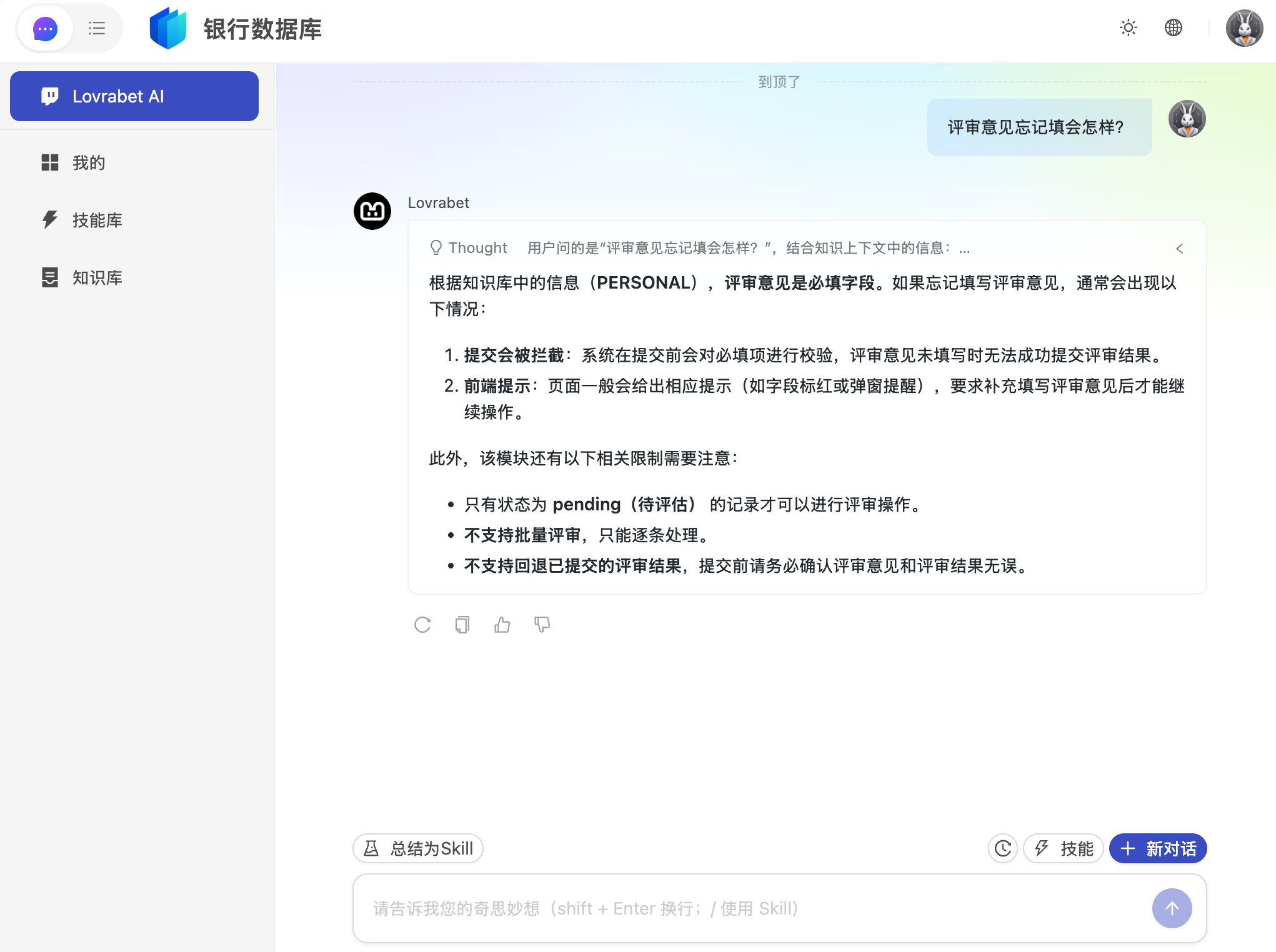
| Which orders are high-risk this week? | High-risk order criteria, order status meanings | Filters orders by the rules and explains why each one matched |
| How do we handle overdue customer follow-ups? | Overdue definition, ownership split, handling SOPs | Lists the overdue items and suggests next steps |
| Draft a refund approval note for me. | Refund approval rules, notice templates, edge-case guidance | Produces an approval note that matches the team's wording |
| Make my daily report the way I like it. | Personal output preferences, scope, favorite filters | Organizes conclusions, risks, and details to personal preference |
When to add or update knowledge
| Signal | What to do |
|---|---|
| The same business background gets re-explained across many conversations | Capture it as enterprise or personal knowledge. |
| The Agent's grasp of fields, statuses, or rules is unstable | Add field definitions and decision rules. |
| The team has a fixed SOP, but the Agent doesn't follow it | Write the SOP into enterprise knowledge and state its scope. |
| A rule has changed | Update the original entry instead of adding a conflicting one. |
| It's purely personal preference or personal scope | Save it as personal knowledge, out of enterprise knowledge. |
Writing knowledge well
- Give the title a clear topic, e.g. "High-risk order criteria".
- State the applicable scope first, then the rules.
- Write rules as short sentences or lists — don't just paste long chat logs.
- Spell out exceptions separately.
- Update or retire stale rules promptly so old and new knowledge doesn't conflict.
FAQ
Does the knowledge base replace the database?
No. Databases store business records; the knowledge base stores the background needed to interpret them. When the Agent queries real data, it still goes through datasets, SQL, BFFs, or other runtime capabilities.
Does the knowledge base replace Skills?
No. Knowledge tells the Agent what things mean in the business; a Skill tells it how to run a task. Complex business tasks usually need both.
What if enterprise and personal knowledge conflict?
Fix the enterprise knowledge first. Personal knowledge is for supplementing individual work habits — not for overriding team-wide rules.
Can others see my personal knowledge?
No. Personal knowledge is for the current user alone. Anything the team shares should be organized into enterprise knowledge by an administrator.
Why didn't the Agent use knowledge I just saved?
Usually one of three reasons: the knowledge hasn't finished indexing; the question doesn't match how the knowledge is worded; or the entry is too vague, with no clear scope or keywords.